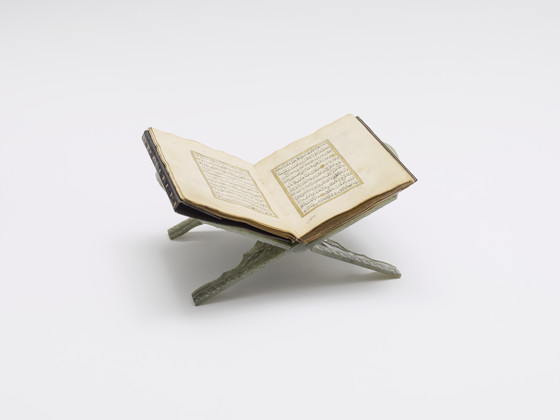
Qur'an Stand (rehal)
* Nearly 20,000 images of artworks the museum believes to be in the public domain are available to download on this site. Other images may be protected by copyright and other intellectual property rights. By using any of these images you agree to LACMA's Terms of Use.

Qur'an Stand (rehal)

India, Mughal Empire, 19th century
Furnishings; Accessories
Light green nephrite jade
9 1/2 x 6 3/16 x 3/8 in. (24.13 x 15.72 x .95 cm)
From the Nasli and Alice Heeramaneck Collection, Museum Associates Purchase (M.76.2.19)
Not currently on public view

Curator Notes

...
Ingeniously fashioned from a single slab of jade, this Qur’an stand features a hinge made of interlocking tabs, known as knuckles, rather than pivoting on an inserted pintle. The leaves of the opened joint form a V-shaped support for a book, which was used during reading and reciting scripture. The exterior upper surfaces are embellished with low relief representations of a stylized flowering plant with a broad overhang of fronds and fruit, and Mughal-style folded-over ground leaves growing out of a rocky mound. It is perhaps intended as a Tree of Life. The bookstand’s hemispherical top and vertical sides have an outer border of upright triangles with solid interstices. The basal border of the upper section is a horizontal row of linked lozenges. The feet of the stand are in the form of a lobed ogival arch with a blossom and splayed foliage in the interstices. Qur’an stands and bookstands for Hindu and Sikh religious texts have been made in a range of materials. The most common is wood, sometimes inlaid with mother-of-pearl and/or lacquered. Additional mediums include jade, jade simulants, precious metals, and monolithic stone. For a jade simulant example, see M.73.5.118.
More...

Bibliography

  • Komaroff, Linda. Beauty and Identity: Islamic Art from the Los Angeles County Museum of Art. Los Angeles: Los Angeles County Museum of Art, 2016.
  • Rosenfield, John.  The Arts of India and Nepal: The Nasli and Alice Heeramaneck Collection.  Boston:  Museum of Fine Arts, Boston, 1966.