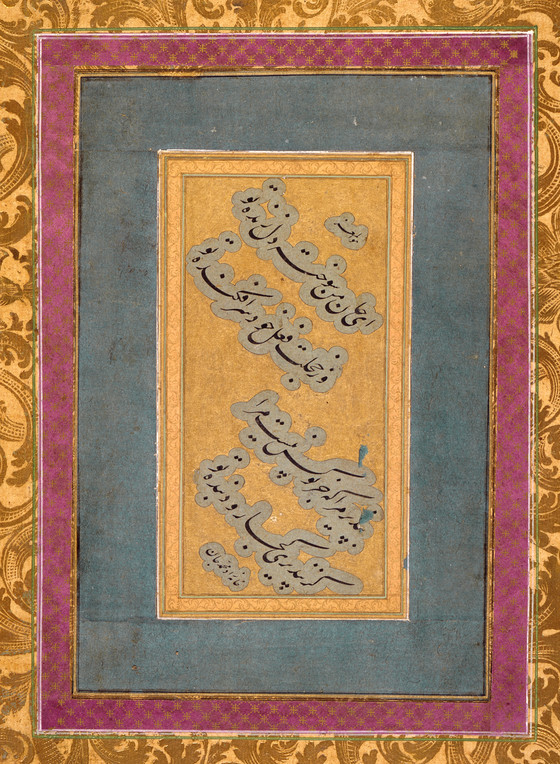
Sultan Muhammad Adil Shah of Bijapur (r. 1627-1656) and his African Prime Minister Ikhlas Khan (d. 1656) (recto); Calligraphy (verso)
* Nearly 20,000 images of artworks the museum believes to be in the public domain are available to download on this site. Other images may be protected by copyright and other intellectual property rights. By using any of these images you agree to LACMA's Terms of Use.

Sultan Muhammad Adil Shah of Bijapur (r. 1627-1656) and his African Prime Minister Ikhlas Khan (d. 1656) (recto); Calligraphy (verso)

India, Karnataka, Bijapur (recto); Iran or India (verso), circa 1670 (recto), 17th century (verso)
Drawings; watercolors
Opaque watercolor and gold on paper; border: paper embossed with gold
Sheet: 17 3/8 x 11 3/8 in. (44.13 x 28.89 cm); Image (recto): 9 5/8 x 7 5/8 in. (24.45 x 19.37 cm); Image (verso): 5 7/8 x 2 7/8 in. (14.92 x 7.30 cm)
From the Nasli and Alice Heeramaneck Collection, Museum Associates Purchase (M.76.2.35)
Not currently on public view

Curator Notes

Recto: This is a double portrait of Sultan Muhammad Adil Shah of Bijapur (r. 1627-1656) and his African Prime Minister Ikhlas Khan (d. 1656)....
Recto: This is a double portrait of Sultan Muhammad Adil Shah of Bijapur (r. 1627-1656) and his African Prime Minister Ikhlas Khan (d. 1656). Muhammad Adil Shah was the seventh ruler of Bijapur in the Adil Shahi dynasty (1490-1686). He signed a peace treaty in 1636 with the Mughal Emperor Shah Jahan (r. 1627-1658) after joining the Mughals in their military campaigns against the Ahmednagar Sultanate (1490-1636). His Prime Minister Ikhlas Khan, also known as Malik Raihan Adil Shah, was a Habshi or African noble of Abyssinian descent who had a long history of serving Bijapur beginning under Sultan Ibrahim Adil Shah II (r. 1580–1627) and rose to hold several powerful positions at court. Given Muhammad Adil Shah’s alliance with the Mughals, it is not unexpected that the stately portrait is rendered realistically in the contemporaneous Mughal style with the nimbate Sultan holding a floral sprig, a symbol of refinement, and standing against a pale blue sky with several varieties of flowering plants accenting the green ground line. The painting is mounted with 18th-century borders embossed in gold with figural and landscape motifs. See also M.81.8.9. Verso: A page of nastaliq calligraphy. The poetic verses in cloud bands have been translated as follows: O my life burns for your wisdom, and from its deed hangs its head in shame before you, For if you do not accept me, where shall this follower of yours go? The child of the slave, Muhammad Yar. (Translation by Z. Faridany-Akhavan.)
More...

Bibliography

  • Overton, Keelan, Ed. Iran and the Deccan: Persianate Art, Culture, and Talent in Circulation, 1400-1700. Bloomington: Indiana University Press, 2020.
  • Rosenfield, John.  The Arts of India and Nepal: The Nasli and Alice Heeramaneck Collection.  Boston:  Museum of Fine Arts, Boston, 1966.
  • Overton, Keelan, Ed. Iran and the Deccan: Persianate Art, Culture, and Talent in Circulation, 1400-1700. Bloomington: Indiana University Press, 2020.
  • Rosenfield, John.  The Arts of India and Nepal: The Nasli and Alice Heeramaneck Collection.  Boston:  Museum of Fine Arts, Boston, 1966.
  • Heeramaneck, Alice N.  Masterpieces of Indian Painting : From the Former Collections of Nasli M. Heeramaneck.  New York:  A.N. Heeramaneck, 1984.
  • Pal, Pratapaditya. Indian Painting, vol.1. Los Angeles: Los Angeles County Museum of Art, 1993.
More...