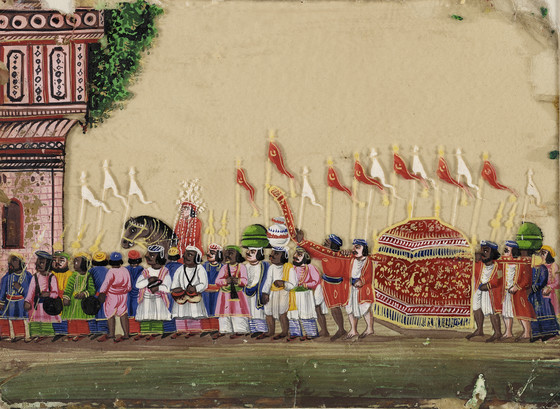
A Muslim Bridegroom's Marriage Procession
* Nearly 20,000 images of artworks the museum believes to be in the public domain are available to download on this site. Other images may be protected by copyright and other intellectual property rights. By using any of these images you agree to LACMA's Terms of Use.

A Muslim Bridegroom's Marriage Procession

India, West Bengal, Murshidabad, circa 1800-1825
Drawings; watercolors
Opaque watercolor on mica
5 1/4 x 7 1/8 in. (13.34 x 18.1 cm)
Gift of Miss Gertrude McCheyne (37.28.10)
Not currently on public view

Curator Notes

Beginning in the early 19th century in Murshidabad, images of festivals, ceremonies, occupations, and transportation modes were painted on mica....
Beginning in the early 19th century in Murshidabad, images of festivals, ceremonies, occupations, and transportation modes were painted on mica. Known colloquially as talc paintings, mica was used by artists for making tracings as models (namuna) of their ancestral paintings. Mica was mined in the Chota Nagpur Plateau in eastern India. The mica crystals could be cleaved into thin elastic plates, which were suitable as a ground for illustrations and for making lanterns. By the middle of the 19th century, mica painting spread to Patna, Bihar; Benares (Varanasi), Uttar Pradesh; and Trichinopoly (Tiruchirappalli), Puddukkottai, and Srirangam, Tamil Nadu. Each venue produced mica paintings in their own regional styles of standard and idiosyncratic subjects, including natural history studies done in Trichinopoly. Hundreds of mica paintings were collected by British patrons and visitors, many of which were sent home as gifts. By the end of the 19th century, the artform had been largely supplanted by photography. In this painting, the bridegroom dressed in princely attire with floral garlands proceeds on horseback to the bride’s house. He is accompanied in the daytime marriage procession by male musicians, bodyguards, servants, and palanquin bearers. The covered palanquin holds his female relatives. Standards flying flags with a crescent moon and star imply that it is a Muslim wedding. See also M.85.180.
More...