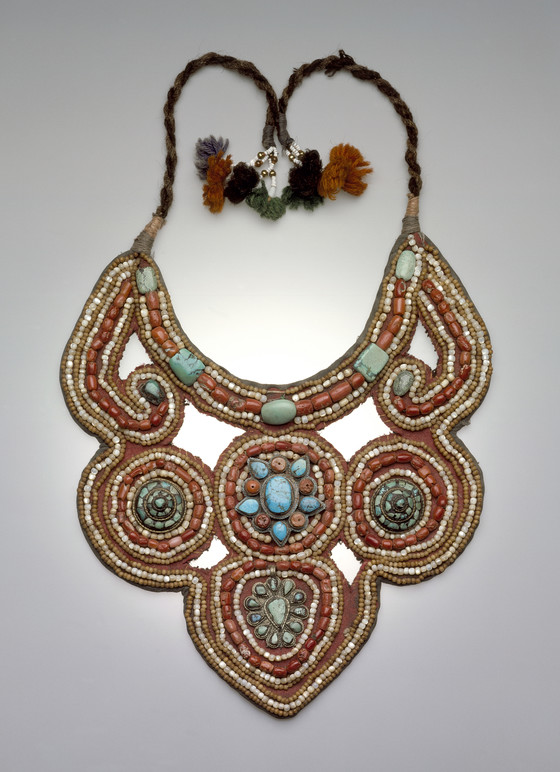
Ceremonial Necklace

* Nearly 20,000 images of artworks the museum believes to be in the public domain are available to download on this site. Other images may be protected by copyright and other intellectual property rights. By using any of these images you agree to LACMA's Terms of Use.

Ceremonial Necklace

Northwestern Nepal or Tibet, 19th century
Jewelry and Adornments
Turquoise, coral, mother-of-pearl beads, and bone beads; silver and copper mounts; cloth backing; yarn ties with glass and brass beads
11 x 10 x 1 in. (27.94 x 25.4 x 2.54 cm)
Gift of Helene and Dr. Joseph Pollock (M.89.112.1)
Not currently on public view

Curator Notes

...
This ceremonial necklace (suta) was worn by children in the Kathmandu Valley during initiation rituals and was also used to adorn religious images. It is in the form of a ceremonial gorget, which was originally a European type of metal or leather body armor worn to protect the throat and upper chest. The Himalayan ornamental derivation was typically a cloth ground with gemstones fixed in symbolic and decorative designs. Here, the center of each of the four large circular fields of ornamentation has a lotus medallion created by the grouping of gemstones inlaid in silver (central top and bottom) or copper (flanking). See Oppi Untracht, Traditional Jewelry of India (New York: Harry N. Abrams, 1997), p. 155, no. 276; and John Clarke, Jewellery of Tibet and Himalayas (London: V&A Publications, 2004), p. 59, no. 41 and p. 114, no.113. Comparable Nepalese ceremonial gorgets made of gilt silver or copper inlaid with gemstones, are in the Asian Art Museum, San Francisco (B60M22+); British Museum, London (1961,1214.1); and the Victoria and Albert Museum, London (IM.296&A-1913). See also M.86.191.3.
More...