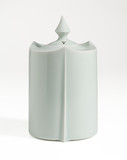
Fukami Sueharu was born (1947) into a Kyoto family of ceramicists who specialized in Chinese-style porcelain wares. Fukami received formal training in ceramics, graduating in 1963 from the Kyoto Ceramics Training School, and by 1968 had won his first award. Drawn to sculpture at an early age, in the mid-1970s, he began to venture beyond the traditions that he had grown up with, forging a path toward creating new – his own – traditions with celadon-glazed porcelain. In 1974, he received the Grand Prize at the Kyoto Arts and Crafts Exhibition, then a second Grand Prize in 1985 at the Faenza International Competition of Contemporary Ceramics, and again at the Chūnichi International Ceramic Exhibition.
Fukami produces sculptural works using a blueish white glaze (seihakuji) in forms that are reminiscent of the ocean horizon, blades, flying birds, or waves. His graceful sculptures can be either horizontal or vertical forms, some of the latter reaching heights of nearly six feet. Others, such as Seascape II (.11), are bowl-like with a single delicate line breaking through the upper surface. Like this example, Fukami’s porcelain sculptures are typically placed on specially made wood bases.
While for many potters it is important that their wares show traces of hand fabrication such as throw lines or finger impressions, Fukami strives to create works that exhibit no evidence that hands ever touched the clay. Rather than imbuing the work with messages from the artist’s hand, Fukami’s goal is to create powerful forms that speak for themselves.
Perhaps Fukami’s greatest achievement in working with porcelain is the impossibly smooth, sharp edged, and clean lines that he is able to achieve. To do this Fukami developed a special pressure casting technique, one that remains a carefully guarded secret. The precise execution of Fukami’s designs could be achieved no other way. He works in a space that looks more like a mechanics workshop than a ceramics studio.
The process begins with slip casting, as Fukami casts his work in a plaster mold and then pumps liquid clay under high pressure into the mold. Once the work is dry enough, Fukami carves it with various metal tools. Using an air compressor to apply the glaze allows for even coating. Though Fukami has nearly perfected his process, it is not without challenges. The edges on his works can be razor thin – some just a millimeter or two wide – and frequently crack during firing. His work is executed in small editions, or are one of a kind. Each piece takes three months to complete and they are fired one at a time. Each work must meet Fukami’s exacting standards: imperfect works do not leave the studio.
Beginning in his late twenties, Fukami entered his work in many domestic and international juried exhibitions. Today his work is shown in group and solo exhibitions, and is collected by museums all over the world. Over the course of his career, Fukami’s work with porcelain as a medium for sculpture has greatly shaped both the world of Japanese ceramics and the international field of contemporary art. He has become arguably one of the most internationally acclaimed sculptors working in clay today.
Chris Drosse
Fukami Sueharu
2 records
Include records without images
About this artist