Table

* Nearly 20,000 images of artworks the museum believes to be in the public domain are available to download on this site. Other images may be protected by copyright and other intellectual property rights. By using any of these images you agree to LACMA's Terms of Use.

Table

Tibet, 16th-17th century
Furnishings; Furniture
Wood with mineral pigments; metal fittings
16 x 31 x 13 in. (40.64 x 78.74 x 33.02 cm)
Gift of Ruth Hayward, Ph.D. and Robert Hayward, M.D., in honor of Tibetan Buddhism, Tibetan people, art and culture, through the 2010 Collectors Committee (M.2010.78.6)
Not currently on public view

Curator Notes

...
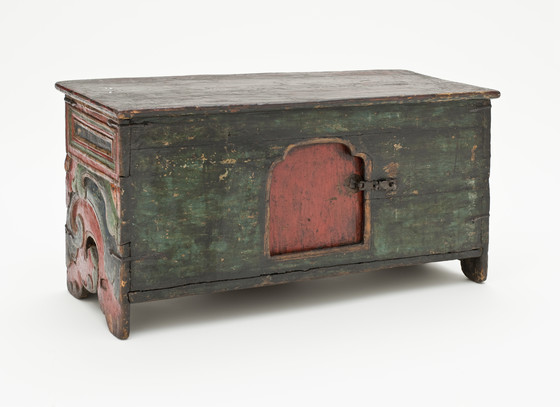
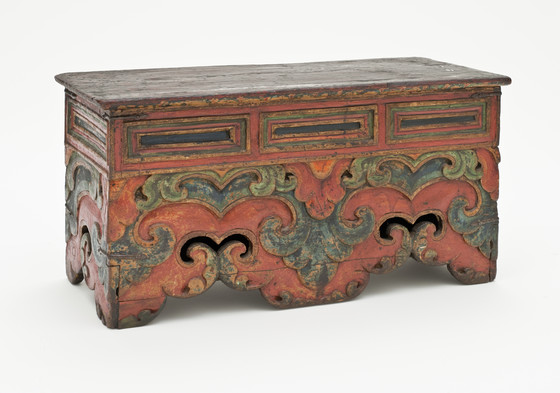
This brilliantly painted small table takes its principal design conception and decoration program from the ancient Chinese decorative and symbolic motif of Auspicious Clouds (xiangyun) that was featured in Chinese painting, textiles, furniture, and architecture as early as the Shang Dynasty (1600-1046 BCE). In Chinese culture, clouds (especially five-colored clouds) are believed to be an auspicious harbinger and symbolic of Heaven, happiness, and prosperity. In Buddhism, clouds can symbolize the transitory nature of existence, much like the ephemeral nature of clouds. A large cloud-form apron extends around the lower front and sides of the table, and functions as its legs. Pendant foliage branches in the center spread across the upper edge and down as corner wraps. The upper third of the table is a multicolored series of rectangles within rectangles. The now-unadorned topboard has a rounded edge embellished with painted scrolling foliage. The plain back is painted green and has a red sliding compartment door with a lobed opening and locking hasp. See David Kamansky, ed., Wooden Wonders: Tibetan Furniture in Secular and Religious Life (Pasadena: Pacific Asia Museum and Chicago: Serindia Publications, 2004), pp. 198-199, no. 22.
More...