

Curator Notes
Tibetan painted trunks were used in monasteries to store precious items, particularly luxury textiles imported from China, India, and Europe (see M.2006.156.1 and M.2013.183.1). See Luca Corona and Camilla Hulse Corona, "Tibetan Furniture: Construction, Form and Function," in David Kamansky, ed., Wooden Wonders: Tibetan Furniture in Secular and Religious Life (Pasadena: Pacific Asia Museum and Chicago: Serindia Publications, 2004), pp. 46-48.
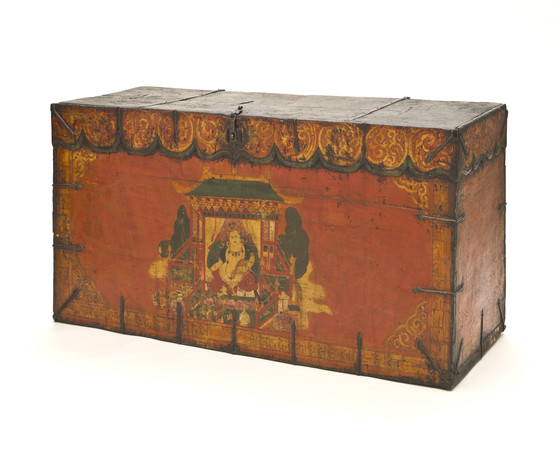
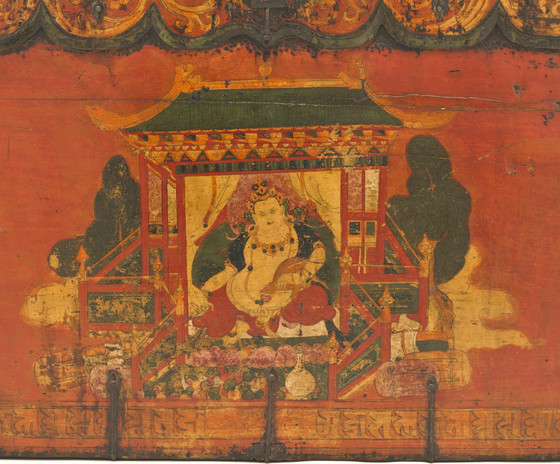
This large trunk is adorned with a prominent representation of Yellow Jambhala, Buddhist God of Wealth. According to Vajrayana Buddhist theological belief, there are five Jambhalas differentiated by color, invocation mantra, proprietary function, Buddha family, and iconography. They represent distinct aspects of enlightened prosperity and generosity, collectively forming a mandala of wealth deities. Yellow Jambhala is a frequently propitiated emanation of the Jina Buddha Ratnasambhava (also yellow in color), and was usually depicted only on early Tibetan trunks, such as this excellent example.
The crowned and bejeweled Jambhala is enthroned in a Tibetan pavilion. In his left hand, he holds a jewel-spewing mongoose named Nehulay. In his right hand, he carries a citron (jambhira). Displayed before him are precious gems and a lidded flask (surahi). In the bottom border is an inscription written in Lantsa script. Along the flush top of the trunk is a faux overhang embellished with golden scrolling medallions. It replicates the actual overhangs on Tibetan leather trunks (see M.2010.78.10 and M.2010.83.2). The trunk has the standard metal reinforcement fittings on the corners and edges of the trunk, and a hasp latch
See Kamansky, ed., Wooden Wonders, pp. 232-233, no. 57.
More...