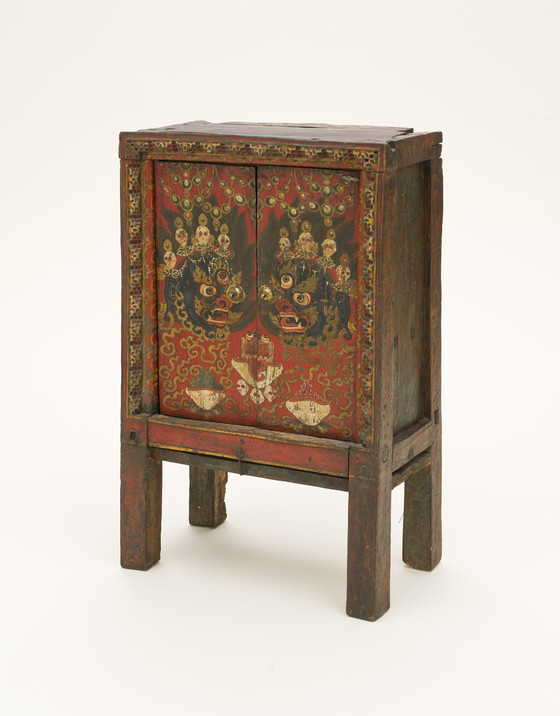
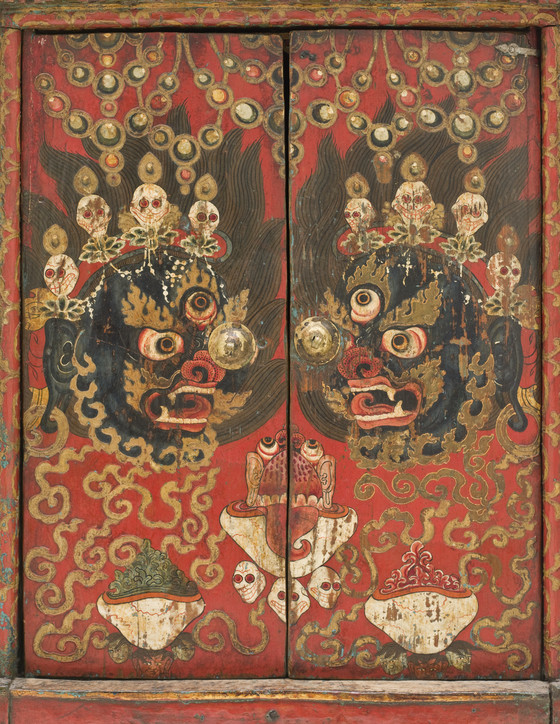
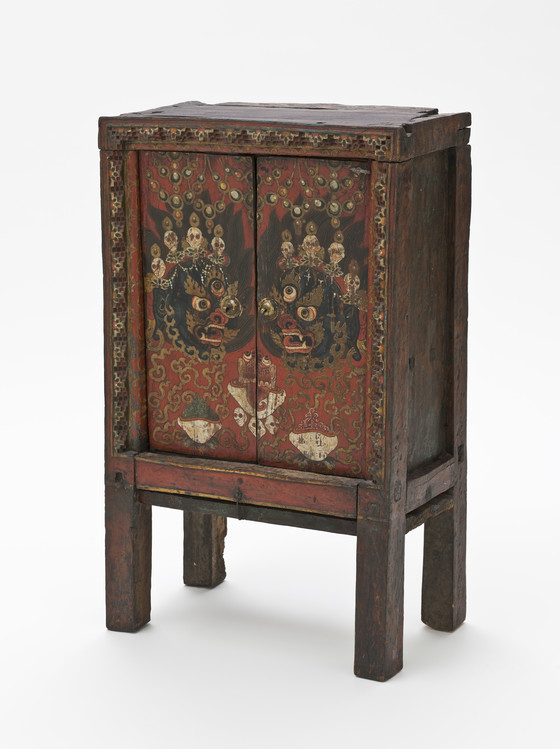
Offering Cabinet (Torgam) with Blue Mahakala and Tantric Offerings
* Nearly 20,000 images of artworks the museum believes to be in the public domain are available to download on this site. Other images may be protected by copyright and other intellectual property rights. By using any of these images you agree to LACMA's Terms of Use.

Offering Cabinet (Torgam) with Blue Mahakala and Tantric Offerings

Tibet, 18th-19th century
Furnishings; Furniture
Wood with mineral pigments, gilding, and gesso; brass fittings
33 x 20 1/4 x 11 1/4 in. (83.82 x 51.44 x 28.58 cm)
Gift of Ruth Hayward, Ph.D. and Robert Hayward, M.D., in honor of Dharmapala (protector of Dharma) Mahakala, through the 2010 Collectors Committee (M.2010.78.3)
Currently on public view:
Resnick Pavilion, floor 1

Since gallery displays may change often, please contact us before you visit to make certain this item is on view.

Curator Notes

...
This offering cabinet (torgam) would have been used in the Protectors’ Chapel (gonkang) of a Tibetan monastery to protect and conceal consecrated cakes (torma) made of butter and roasted barley flour. They were offered as propitiation to the Buddhist protective deities (Sanskrit: dharmapala; Tibetan: ch’os-skyon), who are believed to defend Buddhism and its teachings and institutions, as well as to destroy the hindrances of its followers. Monks make offerings to the dharmapalas for their aid in overcoming negative forces that prevent enlightenment. Lay Buddhists also worship them to obtain earthly blessings, such as the attainment of wealth or longevity. The decoration of the monastic offering cabinets was associated with wrathful deities, and many were painted with Tantric imagery. The leader of the dharmapala is Mahakala (Sanskrit: Great Time/Death), who is known in Tibetan as nag po chen po (Great Black One). He can be depicted with either black or blue skin color. Mahakala’s frightening face and spiritual anger are thought to overcome obstacles and enemies of Buddhism. The front of the cabinet is adorned with two mirror-image floating fierce faces of Blue Mahakala. He has a crown of skulls, snarling mouth, and three bulging eyes enabling him to see the past, present, and future. Beneath him are three skull cup offerings filled with human substances. The central skull cup contains eyes, ears, tongue, heart, and other organs. The top is embellished with a jewelry swag and the bottom with scrolling flames or foliage in gold. The doors are set within an architectural border pattern of mini cubes (chötseg). Additional architectural details are painted in the interior. See also M.2005.94.1 and M.2006.62.2. See David Kamansky, ed., Wooden Wonders: Tibetan Furniture in Secular and Religious Life (Pasadena: Pacific Asia Museum and Chicago: Serindia Publications, 2004), pp. 310-311, no. 129.
More...

Bibliography

  • Little, Stephen, Tushara Bindu Gude, Karina Romero Blanco, Silvia Seligson, Marco Antonio Karam. Las Huellas de Buda. Ciudad de México : Instituto Nacional de Antropología e Historia, 2018.
  • Little, Stephen, and Tushara Bindu Gude. Realms of the Dharma: Buddhist Art across Asia. Los Angeles: Los Angeles County Museum of Art, 2025.

Exhibition history

  • Ritual Offerings in Tibetan Art Los Angeles, CA, Los Angeles County Museum of Art, September 13, 2014 - October 25, 2015