

Curator Notes
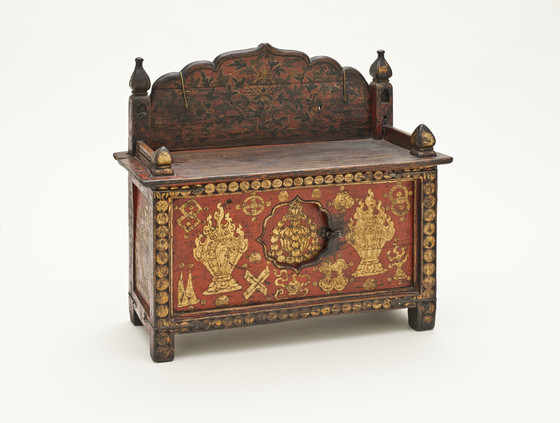
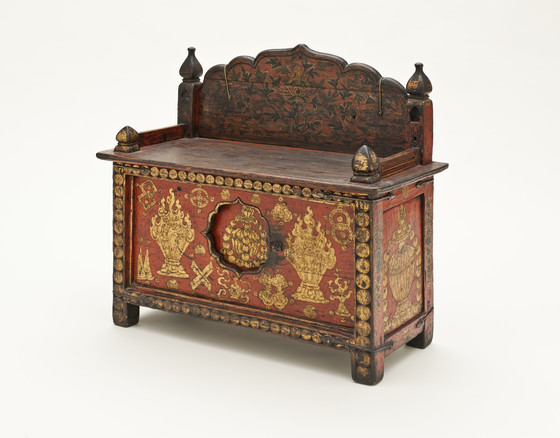
Tibetan furniture served a wide range of functions in domestic, monastic, and temple settings. This is an elegant example of a type of chest used for storing books and implements (pegam), which is derived from the Tibetan words for "book" (pecha) and "box" (gam). The top section consists of a scalloped back panel embellished with a flowering plant and precious jewel, now-missing molded side panels, and book stops in the form of gilded lotus bud finials. It functioned as a reading stand for the sacred scriptures read during rituals that were made in the horizontal format of Tibetan religious books with unbound wooden covers (see M.71.1.48, M.78.101.1, and M.86.345.12). See David Kamansky, ed., Wooden Wonders: Tibetan Furniture in Secular and Religious Life (Pasadena: Pacific Asia Museum and Chicago: Serindia Publications, 2004), p. 285, no. 106.
The chest is painted with a red background with black accents and adorned with various auspicious symbols in gesso and gilding. The front has two large flaming jewels in gold flanking a gold offering vase in the center painted on the small sliding compartment door with a lobed opening and locking hasp. Surrounding the flaming jewels are a variant of the precious group of seven auspicious royal gems (sapta ratna) that served as insignias for the ancient South Asian cultural concept of the Universal Monarch (chakravartin). Beginning in the top left of the upper row are the square earrings of the minister, a superfluous symbol of the Buddhist Wheel of the Law (dharmachakra), the triple-eyed gem (tri ratna), and the round earrings of the queen. The bottom row left to right has the unicorn or rhinoceros horns, the stylized crossed swords that were the Chinese insignia of the military general, an indeterminate symbol, and a branch of coral on a stand. The symbol of the pair of elephant tusks is missing. Interspersed between these symbols are six round precious jewels. The central jewel is festooned with streamers. The central panel on the front has a border of gold circles against a black ground. The two end panels each have a treasure vase overflowing with jewels. Auspicious symbols are painted in gold on the back. See Robert Beer, The Encyclopedia of Tibetan Symbols and Motifs (Boston: Shambala Publications, 1999), p. 165, pl. 79.
More...