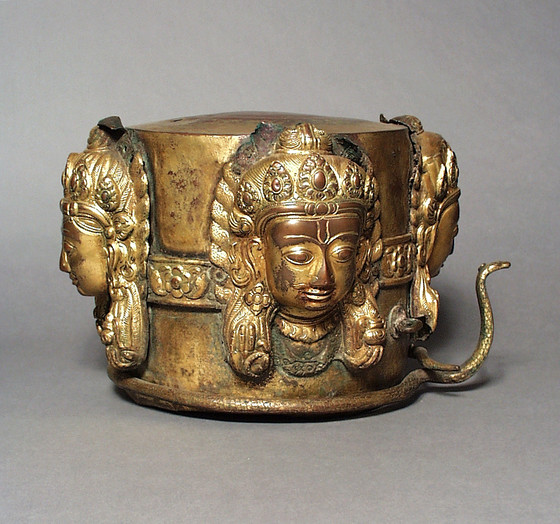
Shivalinga Cover with Four Faces
* Nearly 20,000 images of artworks the museum believes to be in the public domain are available to download on this site. Other images may be protected by copyright and other intellectual property rights. By using any of these images you agree to LACMA's Terms of Use.

Shivalinga Cover with Four Faces

Nepal, 13th century
Sculpture
Gilt repoussé brass
unspecified (unspecified): 9 1/4 x 13 1/2 in. (23.5 x 34.29 cm) unspecified1 (unspecified): 9 1/4 x 13 1/2 in. (23.5 x 34.29 cm)
Gift of Eivor and Dr. Alston Callahan, Birmingham, Alabama (M.82.166a-b)
Not currently on public view

Curator Notes

...
Since around the beginning of the Common Era, the Shivalinga (literally, the "sign" of Shiva) has been the quintessential symbol and artistic form used to represent the major Hindu god Shiva. In its core conception imagined as an aniconic column, the Shivalinga symbolizes the deity’s transcendental nature and primordial potency. As iconic imagery became increasingly prevalent in South Asian art, the Shivalinga was anthropomorphized by the addition of Shiva’s head emerging from the stone column in order to provide worshippers with a physical form that was considered more accessible than the abstract expression of his imperceptible reality. Multiple heads of Shiva were subsequently added to represent different philosophical aspects of the god. Alternatively, as is the case here, a metal cover with various faces of Shiva would have covered a plain stone shaft. To seek blessings from Shiva, devotees worship lingas with ritual offerings of flowers, food, and incense. The deity’s large eyes and welcoming gaze are thought to help worshippers establish a personal spiritual bond, thus strengthening the power of their offering. This four-faced Nepalese linga cover, attributed to the 13th century, is distinctive for its heads being fashioned separately as repoussé busts rather than the heads being integrally cast, as in M.85.279.5. It is also unusual for having a projecting serpent encircling the base and a decorative floral band around his midsection.
More...

Bibliography

  • Phil Freshman. Los Angeles County Museum of Art Report, July 1, 1981-June 30, 1983. Los Angeles: Los Angeles County Museum of Art, 1984.
  • Pal, Pratapaditya. Art of Nepal. Los Angeles: Los Angeles County Museum of Art; University of California Press, 1985.
  • Phil Freshman. Los Angeles County Museum of Art Report, July 1, 1981-June 30, 1983. Los Angeles: Los Angeles County Museum of Art, 1984.
  • Pal, Pratapaditya. Art of Nepal. Los Angeles: Los Angeles County Museum of Art; University of California Press, 1985.
  • Reedy, Chandra L.  Himalayan Bronzes:  Technology, Style and Choices.  Newark:  University of Delaware Press, 1997.
More...