Goddess (Devi)

* Nearly 20,000 images of artworks the museum believes to be in the public domain are available to download on this site. Other images may be protected by copyright and other intellectual property rights. By using any of these images you agree to LACMA's Terms of Use.

Goddess (Devi)

Indonesia, Central Java, 9th-early 10th century, with later reworkings
Sculpture
Gold
a) Figure: 6 7/8 x 2 1/2 x 1 1/2 in. (17.46 x 6.35 x 3.81 cm); b) Base height: 1 1/8 in. (2.86 cm); b) Base diameter: 1 7/8 in. (4.76 cm)
Gift of Nancy Wiener in honor of the museum's 40th anniversary (M.2005.213a-b)
Not currently on public view

Curator Notes

...
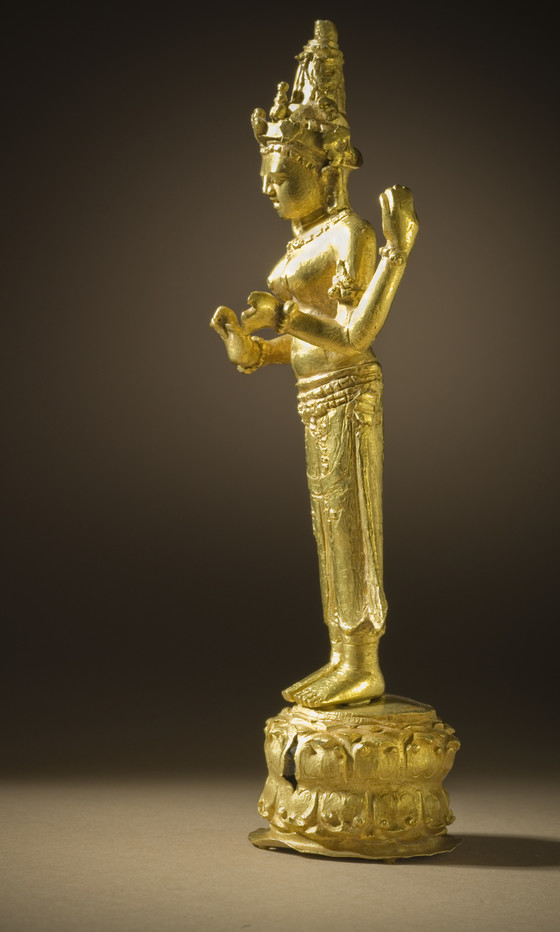
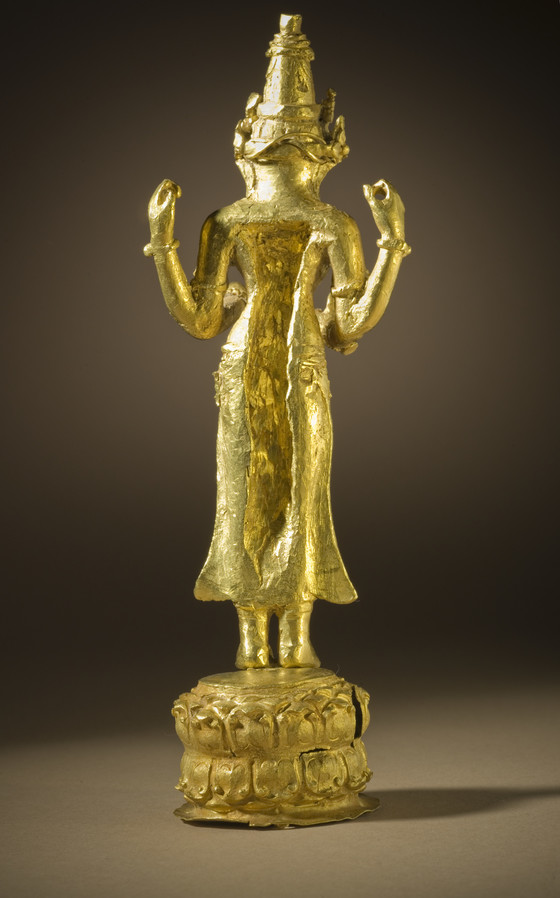
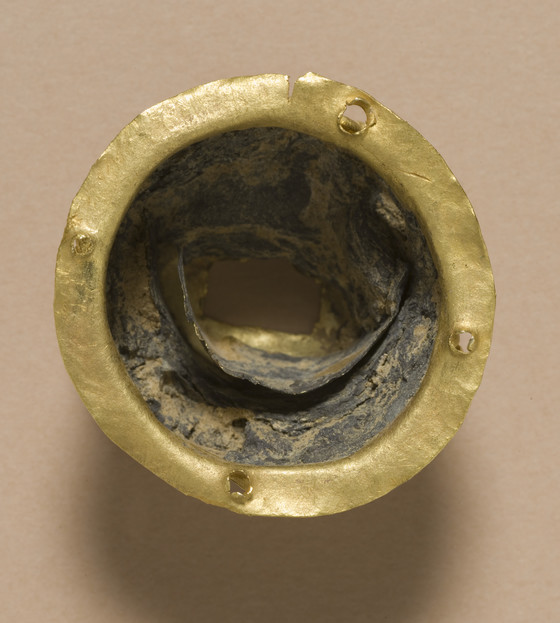
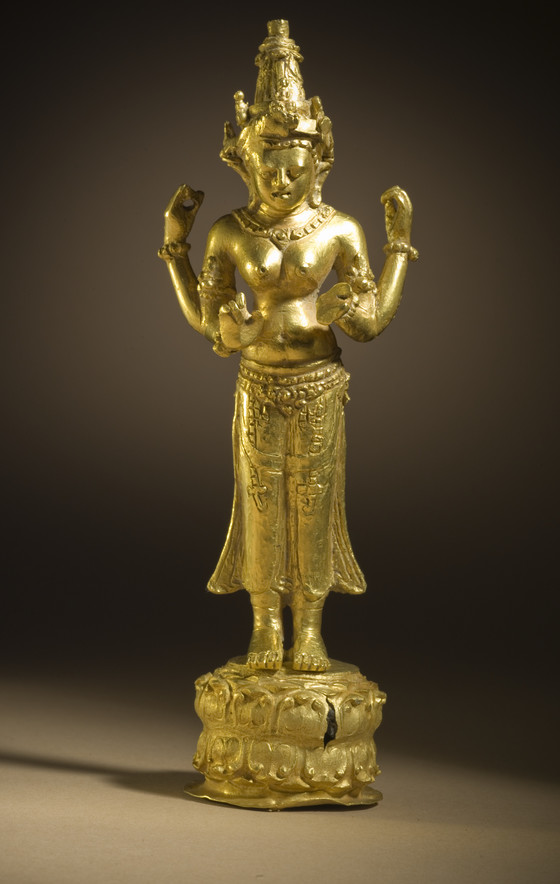
The art of the goldsmith was a highly sophisticated and culturally symbolic craft in ancient Indonesia. Gold was regarded as a symbol of immortality on account of its everlasting brilliance and immunity to decay; accordingly, its earliest use in prehistoric times seems to have been as symbolic burial offerings. Subsequently, gold was used for two primary purposes: as an economic medium of exchange and for jewelry and ornamentation. Historical references from Indonesia, India, China, the West, and the Arab world all attest to the abundance of gold in ancient Indonesia. Although myriad golden objects were fashioned in Java, in actuality deposits of gold are extremely rare there and most of the ancient Javanese gold was probably imported from Kalimantan (Borneo) and Sumatra. The latter island was in fact called the "Golden Island" (Suvarnadvipa) by the Indians who traded extensively with its merchants. Indeed, Indonesia's legendary gold was thought so bountiful that as late as the 16th century a Portuguese traveler in western Indonesia fantastically claimed that "there was so much gold in Java that even dogs had golden collars" (John Miksic, Old Javanese Gold [Singapore: Ideation, 1990], p. 37). This crowned solid gold goddess with four arms is attributed to Central Java, 9th-early 10th century. Its attributes are now missing, so the goddess is now unidentifiable. A large trough on the back of the solid gold figure has been hollowed out, and sections of the fingers and hands were later removed, both presumably for the gold content. The lotus base is hollow. A comparable Central Javanese gold image of Vishnu, attributed to circa 8th-9th century, is in the Museum Nasional, Jakarta (A2/486). See Jan Fontein, The Sculpture of Indonesia (Washington: National Gallery of Art, 1990), pp. 205-206, no. 53.
More...

Bibliography

  • Brown, Robert L. "Selections From the Southeast Asian Art Collection of the Los Angeles County Museum of Art." Arts of Asia 38 (3): 75-87 (May-June 2008)