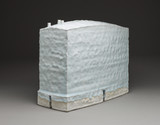
Yoshikawa Masamichi was born in Kanagawa Prefecture, on Sagami Bay, but having graduated from The Japan Design Academy in Tokyo in 1968, he moved to Tokoname in central Japan, and was trained in the studio of Sugie Takumi. He established his own kiln in 1975. Yoshikawa works with a bluish celadon glaze on porcelain (seihakuji), or sometimes blue and white, which is traditionally applied to a smooth surface. Yoshikawa has developed his own techniques of heavily applying the celadon glaze and arranging for drips to occur in specific locations. He carves each face of an object with sharp tools and presses with his fingers for a textured surface on which the celadon glaze reflects variously as one moves by. Fascinated by Han Dynasty Chinese funerary villages and buildings (see M.2012.108.1), Yoshimichi’s designs are based on these structures and slab built. Though fragile, his sculptures evoke solidity. Yoshimichi teaches now at Nagoya University of the Arts, and has had solo shows across the globe. He won grand prizes in 1981 and 1983 at the Asahi Ceramics exhibition. In 2002, he garnered a gold prize for his work at the International Biennale of Ceramic Art Vallauris, France. For his talents, Aichi Prefecture gave him their arts and culture award in 2005. His works are in the collections of the Metropolitan Museum of Art, the Museum of Arts and Design, New York, the Victoria and Albert Museum, and innumerable museums in Japan and across Asia.
hg
Masamichi Yoshikawa
2 records
Include records without images
About this artist