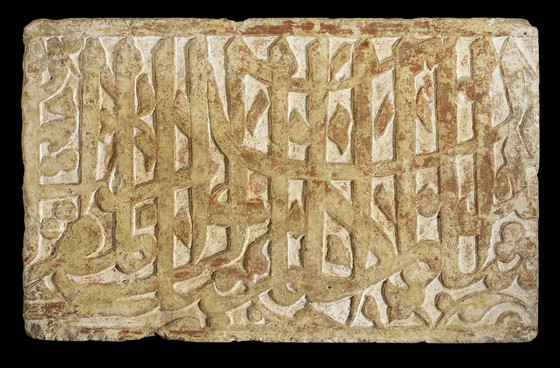
Foundation Stone

* Nearly 20,000 images of artworks the museum believes to be in the public domain are available to download on this site. Other images may be protected by copyright and other intellectual property rights. By using any of these images you agree to LACMA's Terms of Use.

Foundation Stone

Egypt, 15th century
Architecture; Architectural Elements
Marble, carved, with traces of paint and gilding
12 3/4 x 20 1/4 x 3 1/2 in. (32.38 x 51.43 x 8.89 cm)
The Madina Collection of Islamic Art, gift of Camilla Chandler Frost (M.2002.1.29)
Not currently on public view

Curator Notes

...
In late medieval Egypt the ruling elite built and lavishly endowed religious foundations, mainly in Cairo, the capital, which even today is marked by the tall domes, lofty stone facades, and balconied minarets that characterize the architecture of this period. The entrance portals of such buildings often carried elegantly carved stone inscriptions with the names of donors and dates of construction. These stone elements were frequently further embellished by paint, as is the case with this marble inscription whose tantalizing truncated text confirms that it once graced a religious foundation (although the name of the donor and perhaps the date must have been inscribed on an adjacent stone): "This blessed place [was founded] by his (noble) excellency."
More...

Bibliography

  • Lo Terrenal y lo Divino: Arte Islámico siglos VII al XIX Colección del Museo de Arte del Condado de Los Ángeles. Santiago: Centro Cultural La Moneda, 2015.

  • Komaroff, Linda. Beauty and Identity: Islamic Art from the Los Angeles County Museum of Art. Los Angeles: Los Angeles County Museum of Art, 2016.