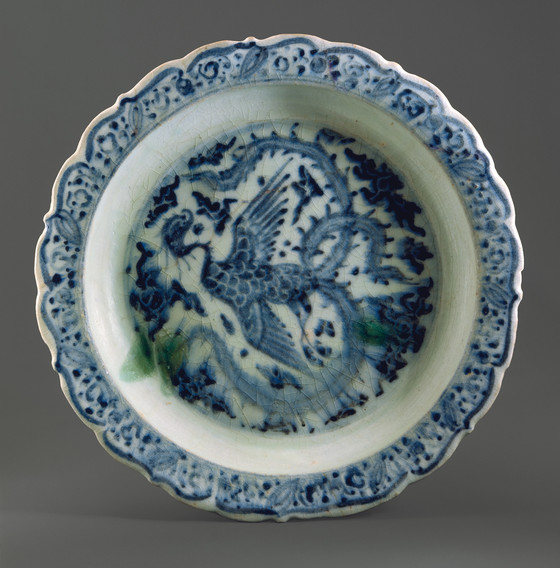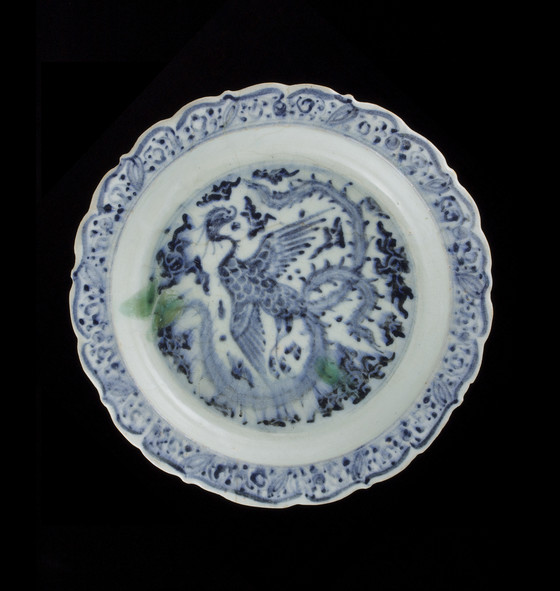
Bowl

* Nearly 20,000 images of artworks the museum believes to be in the public domain are available to download on this site. Other images may be protected by copyright and other intellectual property rights. By using any of these images you agree to LACMA's Terms of Use.

Bowl

Syria, 15th century
Ceramics
Fritware, underglaze-painted
Height: 2 1/4 in. (5.71 cm); Diameter: 13 1/4 in. (33.65 cm)
The Madina Collection of Islamic Art, gift of Camilla Chandler Frost (M.2002.1.72)
Not currently on public view

Curator Notes

...
From the late eighth century imported Chinese ceramics enjoyed great popularity in Islamic lands while Muslim potters imitated their shapes and developed new ways of emulating the whiteness and lightness of porcelain. It was not until after the Mongol invasions of the thirteenth century, however, that Chinese designs were widely adopted in Islamic pottery. Motifs such as lotus flowers and peonies, dragons, and, in the case of this bowl, the phoenix, became commonplace not only in glazed ceramics but also in other luxury mediums, such as inlaid metalwork and silk textiles.
More...

Bibliography

  • Lo Terrenal y lo Divino: Arte Islámico siglos VII al XIX Colección del Museo de Arte del Condado de Los Ángeles. Santiago: Centro Cultural La Moneda, 2015.

  • Carswell, John. Blue and White: Chinese Porcelain and its Impact on the Western World. Chicago: David and Alfred Smart Gallery, 1985.
  • Lo Terrenal y lo Divino: Arte Islámico siglos VII al XIX Colección del Museo de Arte del Condado de Los Ángeles. Santiago: Centro Cultural La Moneda, 2015.

  • Carswell, John. Blue and White: Chinese Porcelain and its Impact on the Western World. Chicago: David and Alfred Smart Gallery, 1985.
  • Hess, Catherine. The Arts of Fire: Islamic Influences on Glass and Ceramics of the Italian Renaissance. Los Angeles: J. Paul Getty Trust, 2004.
More...