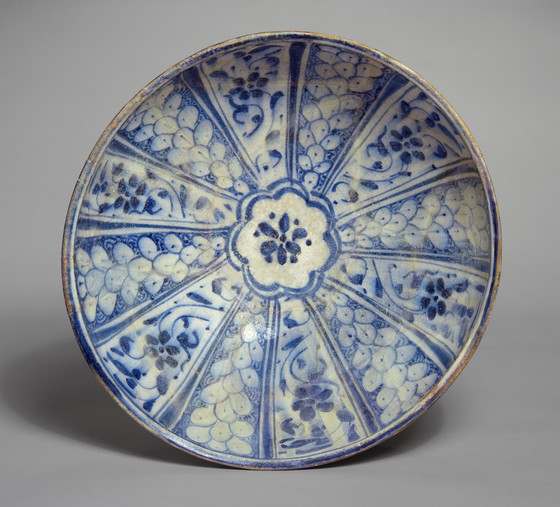
Bowl

* Nearly 20,000 images of artworks the museum believes to be in the public domain are available to download on this site. Other images may be protected by copyright and other intellectual property rights. By using any of these images you agree to LACMA's Terms of Use.

Bowl

Likely Syria or Egypt, 15th century
Ceramics
Fritware, underglaze painted
Height: 4 1/2 in. (11.43 cm); Diameter: 10 in. (25.4 cm)
The Madina Collection of Islamic Art, gift of Camilla Chandler Frost (M.2002.1.52)
Not currently on public view

Curator Notes

...
This is one of three nearly identical bowls in LACMA’s collection, something of a rarity in Islamic ceramics, indicating that they were made in the same potter’s workshop and suggesting that they may have been intended as part of a matched set (see M.2002.1.65 and M.2002.1.67). They were likely produced under the Mamluk dynasty, which ruled Egypt and Syria from 1250 to 1517. Their blue and white color scheme and scrolling leaf and floral designs are typical of late Mamluk ceramics, both tableware and architectural revetment (see M.2002.1.50). As elsewhere in historical Islamic lands, the Mamluk elite were served from gold and silver vessels and especially imported Chinese porcelain, while the upper and middle classes dined from brass and tinned copperwares and glazed ceramics. A set of matched bowls would have been appropriate for the household of a member of one of the latter categories. It is also conceivable that such coordinated vessels may have been used as supplementary tableware as at the large and elaborate banquets hosted by the Mamluk sultans for which vast quantities of leftovers were allotted to the common people, according to textual accounts. Deep bowls of this type would be particularly suitable for serving the meaty stews and broths favored by the Mamluks.
More...

Bibliography

  • Atil, Esin. Renaissance of Islam: Art of the Mamluks. Washington, D.C.: Smithsonian Institution Press, 1981.