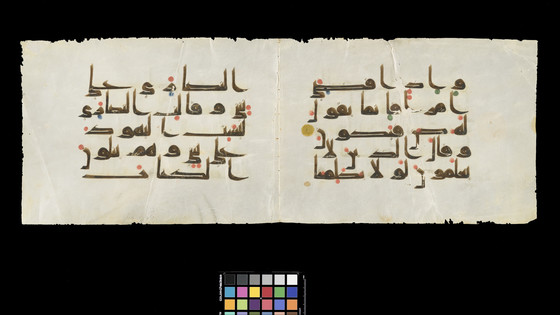
Double page from a Manuscript of the Qur'an (2:113; 2:113 and 2:116-117; 2:117-118)

https://collections-images.lacma.org/remote_images/ma-12928-O3.jpg


Please log in to add this item to your gallery.
View comments
No comments have been posted yet.
Add a comment
Please log in to add comments.
Please log in to add tags.
* Nearly 20,000 images of artworks the museum believes to be in the public domain are available to download on this site.
Other images may be protected by copyright and other intellectual property rights.
By using any of these images you agree to LACMA's Terms of Use.
Double page from a Manuscript of the Qur'an (2:113; 2:113 and 2:116-117; 2:117-118)
Iraq, 9th century
Manuscripts; folios
Ink, colors, and gold on parchment
8 3/4 x 24 1/2 in. (22.225 x 62.23 cm)
Frame: 29 × 23 × 1 1/2 in. (73.66 × 58.42 × 3.81 cm)
The Madina Collection of Islamic Art, gift of Camilla Chandler Frost (M.2002.1.349)
Not currently on public view