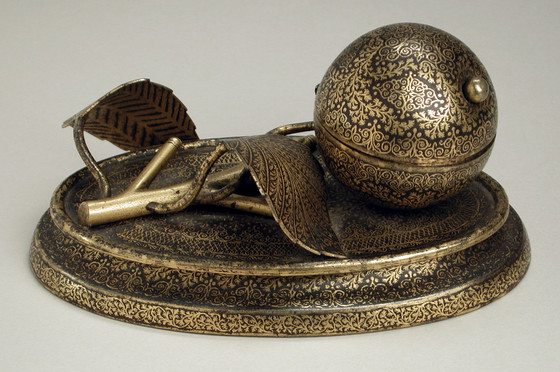
Inkstand

* Nearly 20,000 images of artworks the museum believes to be in the public domain are available to download on this site. Other images may be protected by copyright and other intellectual property rights. By using any of these images you agree to LACMA's Terms of Use.

Inkstand

Pakistan, Panjab, Sialkot or Gujrat, Kotli Loharan, circa 1850-1870
Tools and Equipment; stands
Iron overlaid with gold wire
3 1/4 x 6 1/4 x 3 in. (8.26 x 15.88 x 7.62 cm)
Art Museum Council Fund (M.2000.125)
Not currently on public view

Curator Notes

...
Inspired by the Victorian and Mughal artistic traditions and their mutual interest in representations of the natural world, this imaginative inkstand is fashioned in an organic form of a small branch of an apple tree resting on an oval stand. The apple is hinged on the side so that it opens to reveal the inkwell. The two leaves are elliptical with serrated edges and graceful foliate venation on the top and a chevron-like pattern on the bottom. The decorative program consists of vegetal sprays and flowering vine scrolls interspersed with arabesques, geometric designs, and repetitive curvilinear border motifs. This inkstand’s intricate decoration consists solely of gold wire. The technique involves incising or cross-hatching a design into the iron or mild steel ground with a hard steel needle or liner chisel. Pure gold wire or gold leaf is then hammered into the engraved pattern and the whole object is heated, re-hammered, and polished. Writing sets, typically consisting of an inkstand, pen tray, paper weights, candlestick holder, portfolio binders, and a portable writing desk, were a favored correspondence accouterment of English and Continental residents and travelers in South Asia during the colonial period in the 18th and 19th centuries. Koftgari writing implements were highly favored and complemented by a wide range of additional decorative items and toiletry utensils made in the same technique.
More...