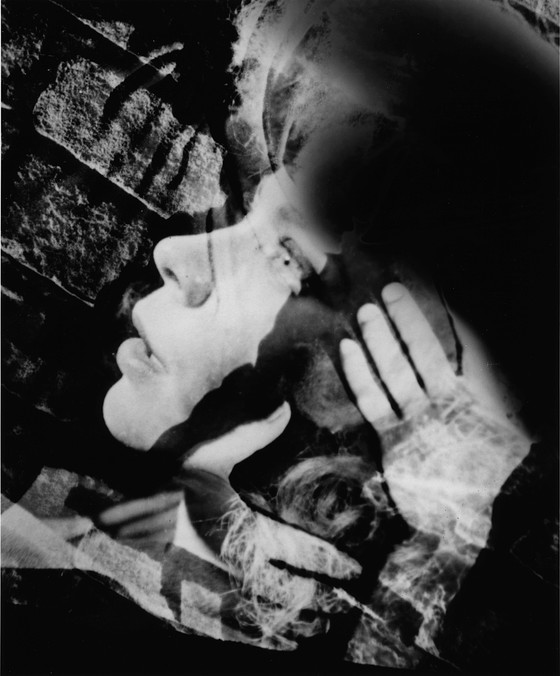
Portrait of a Friend
* Nearly 20,000 images of artworks the museum believes to be in the public domain are available to download on this site. Other images may be protected by copyright and other intellectual property rights. By using any of these images you agree to LACMA's Terms of Use.

Portrait of a Friend

United States, circa 1947
Photographs
Gelatin silver print
Image: 10 15/16 × 9 3/16 in. (27.78 × 23.32 cm) Primary support: 10 15/16 × 9 3/16 in. (27.78 × 23.32 cm) Secondary support: 20 1/16 × 16 in. (50.96 × 40.64 cm) Mat: 22 × 18 in. (55.88 × 45.72 cm)
Purchased with funds provided by the Ralph M. Parsons Fund (M.87.81.1)
Not currently on public view

Curator Notes

Born in Russia, Val Telberg lived in Moscow and in Tungchow, China, before coming to the United States in 1928 to complete his education....
Born in Russia, Val Telberg lived in Moscow and in Tungchow, China, before coming to the United States in 1928 to complete his education. He studied painting at the Art Students League in New York, where he encountered the work of surrealist artists René Magritte and Salvador Dali as well as the films of Jean Cocteau and other experimental filmmakers. Telberg supported himself with a number of odd jobs, including a quick-developing service for nightclub camera girls, and he later ran a comic-photo concession at an amusement park. This commercial work constituted Telberg's introduction to manipulating photographic processes, but by 1945 he had begun a serious exploration of photography. Like Clarence John Laughlin, Telberg uses surrealistic practices, such as allowing accidental juxtapositions of found symbols to express intuitive thoughts. More than Laughlin, Telberg exploits a sense of unreality by using negative images, solarization, and recombined images. His use in the 1940s of composite printing placed his work outside what was then recognized as photography's mainstream. Telberg's interest in cinema, especially the uses of dissolves, has had a profound effect on his work. His photographs, in fact, resemble film footage that has been compressed and collaged rather than left to play out over time. As in Portrait of a Friend, narrative images are arranged with abstract elements in a dense and detailed frame, the layers of overlapping, abstract forms obscuring the realistic imagery. The viewer must determine whether the scene moves forward, backward, or both.
More...

Bibliography

  • Grundberg, Andy; Gauss, Kathleen McCarthy. Photography and Art:  Interactions Since 1946. Fort Lauderdale, Florida:  Museum of Art; Los Angeles, CA:  Los Angeles County Museum of Art, 1987.
  • Price, Lorna.  Masterpieces from the Los Angeles County Museum of Art.  Los Angeles:  Los Angeles County Museum of Art, 1988.