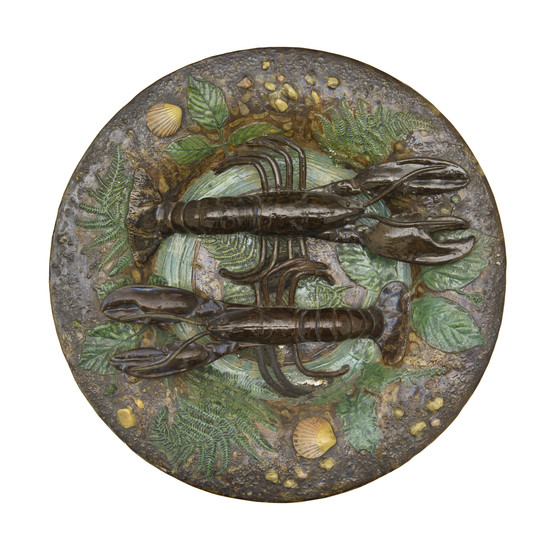
Circular Dish

* Nearly 20,000 images of artworks the museum believes to be in the public domain are available to download on this site. Other images may be protected by copyright and other intellectual property rights. By using any of these images you agree to LACMA's Terms of Use.

Circular Dish

France, 1889-1890
Furnishings; Accessories
Glazed earthenware
Height: 3 in. (7.62 cm) Diameter: 19 1/4 in. (48.9 cm)
Gift of Barbara Barbara and Marty Frenkel (M.2013.193.2)
Not currently on public view

Curator Notes

During the 19th century, there was a craze for work by the Renaissance potter Bernard Palissy (1510-1590) in both France and Portugal, inspiring interest in the originals, and the development of reviv...
During the 19th century, there was a craze for work by the Renaissance potter Bernard Palissy (1510-1590) in both France and Portugal, inspiring interest in the originals, and the development of revival pieces in the same style. In France, the Palissy revival began in Tours. In 1846, Charles-Jean Avisseau (1795-1861) declared that he had rediscovered Palissy’s technical process. At the time, Avisseau was sharing a workshop with his brother-in-law, Joseph Landais (1800-1883), who disputed Avisseau’s claim and set up independently. Landais and his son, Charles-Joseph (1829-1908), won a silver medal at the 1855 Paris Exhibition for a monumental mirror frame bursting with foliage and reptiles. The other major French center of production was established in Paris by Victor Barbizet (c.1805-c.1870). Alfred Renoleau (1854-1930) operated in the southwest of France outside these centers, and was perhaps the most financially successful. This dish with his mark dates to 1889 to 1890, when he was at the Polakowski tile factory producing some of his best work.
More...