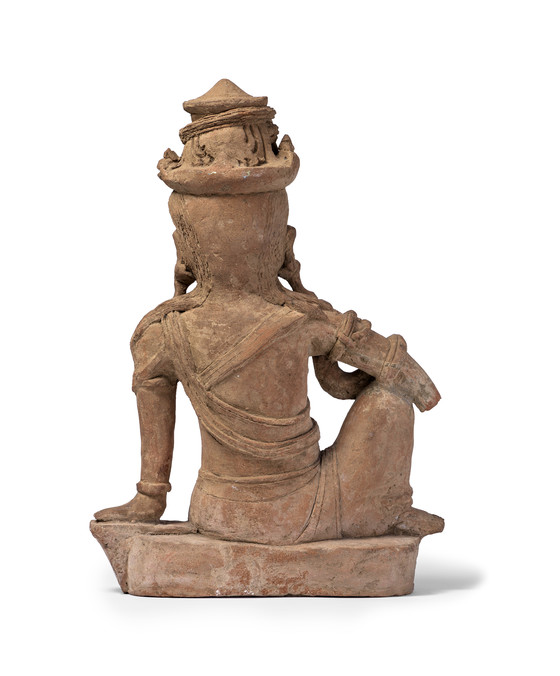
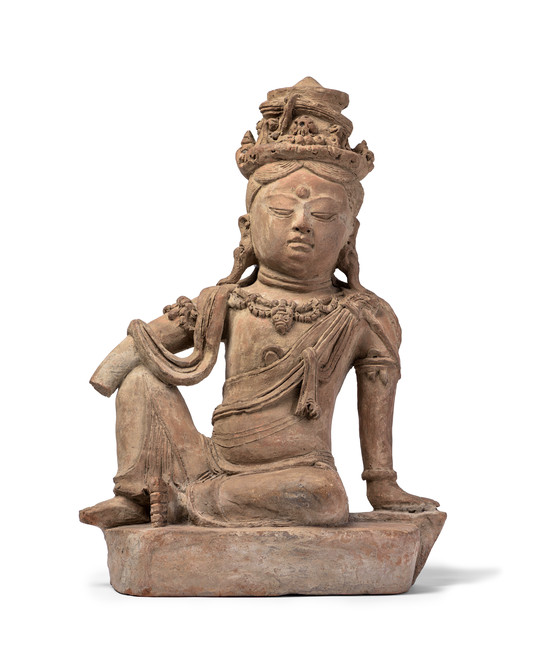
The Bodhisattva Avalokiteshvara
* Nearly 20,000 images of artworks the museum believes to be in the public domain are available to download on this site. Other images may be protected by copyright and other intellectual property rights. By using any of these images you agree to LACMA's Terms of Use.

The Bodhisattva Avalokiteshvara

Indonesia, Eastern Java, 14th century
Sculpture
Earthenware
21 x 15 1/4 x 6 3/4 in. (53.34 x 38.74 x 17.15 cm)
Gift of Paul F. Walter (M.90.196.5)
Currently on public view:
Resnick Pavilion, floor 1

Since gallery displays may change often, please contact us before you visit to make certain this item is on view.

Curator Notes

...
This elegant eastern Javanese portrayal of the Bodhisattva Avalokiteshvara depicts the deity in the posture of royal ease (maharajalila asana). This iconographic form is more typically associated with Chinese Pure Land Buddhism images of the Bodhisattva Avalokiteshvara in his Water Moon Form (Shuiyue Guanyin). For example, see an 11th-century wooden image from China in the Metropolitan Museum of Art, New York (28.56). Avalokiteshvara is represented in this mode when he resides in his mythical abode on Mount Potalaka, which has been variously identified as being located on an island south of India; as Mount Pothigai (or Potiyil) in Tirunelveli District, Tamil Nadu; or as Mount Putuo, an island off the coast of Zhejiang Province, China. Avalokiteshvara’s right hand (now missing) was likely extended in a relaxed position resting on his knee with the palm facing downward and the fingers open. His left hand is placed flat on the ground to support his torso. He has a tiered hat with a pointed peak and a tiara in front. He wears abundant jewelry and a robe over his left shoulder. He has a prominent circular forehead marking (urna) indicating his enlightenment. Chinese merchant immigrants and their descendants have lived in Indonesia, especially eastern Java, since at least the 13th century. Pratapaditya Pal has speculated that this earthenware sculpture may have been based on a pilgrim’s votive model of a Chinese image fashioned in this distinctive posture. (Pal 1987, 74-75, no. 38). For a later Burmese form of Avalokiteshvara seated in this pose, see AC1995.103.1.
More...

Bibliography

  • Little, Stephen, Tushara Bindu Gude, Karina Romero Blanco, Silvia Seligson, Marco Antonio Karam. Las Huellas de Buda. Ciudad de México : Instituto Nacional de Antropología e Historia, 2018.
  • Little, Stephen, and Tushara Bindu Gude. Realms of the Dharma: Buddhist Art across Asia. Los Angeles: Los Angeles County Museum of Art, 2025.
  • Little, Stephen, Tushara Bindu Gude, Karina Romero Blanco, Silvia Seligson, Marco Antonio Karam. Las Huellas de Buda. Ciudad de México : Instituto Nacional de Antropología e Historia, 2018.
  • Little, Stephen, and Tushara Bindu Gude. Realms of the Dharma: Buddhist Art across Asia. Los Angeles: Los Angeles County Museum of Art, 2025.
  • Pal, Pratapaditya. Icons of Piety, Images of Whimsy: Asian Terra-cottas from the Walter Grounds Collection. Los Angeles: Los Angeles County Museum of Art, 1987.
More...