

Curator Notes
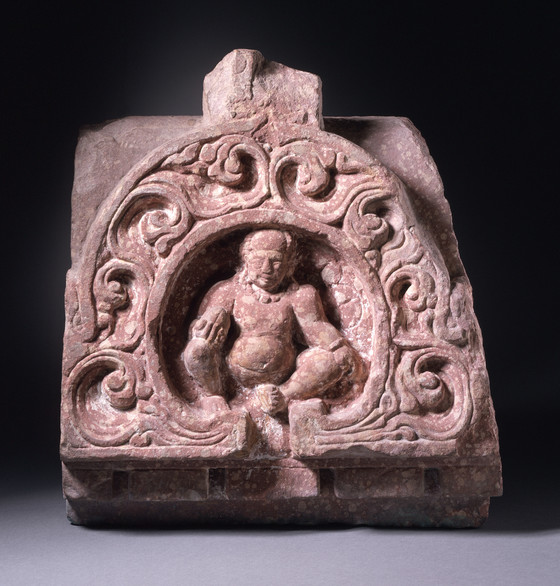
A distinctive feature of both northern and southern Indian temples is the large horseshoe arch (Sanskrit: nasi, or Tamil: kudu) used as a tympanum. In early architecture, it was termed a chaitya arch (named from the rock-cut Buddhist and Jain temples (chaityas) and funerary monuments (stupas). The arch framed the window in the entablature above the shrine’s entrance. Additional historical names are moon-window (chandrashala) and cow’s eye (gavaksha). The form of the horseshoe arch—circular with flared terminals—was derived from the end view of a barrel-vault roof or centered on the roof’s lateral facade.
In this tympanum carved in Mathura’s characteristic mottled red sandstone, the enshrined deity is Kubera, the God of Riches. Also known as Vaishravana or Jambhala, he is venerated by Hindus, Buddhists, and Jains. Kubera was originally the chief of the demigods and guardians of treasures (yakshas). He is also the Regent of the Northern Direction (dikpala). Kubera is portrayed with his characteristic iconography of being potbellied (tundila) and wearing princely ornaments (bodhisattva abharana). He is seated on a lotus base in the kingly posture of royal ease (maharajalila asana) with his left leg lying flat and his right knee raised. His right hand holds a pomegranate (dadima) or citron (jambhira). His left hand rests on his left knee. He has a lotiform aureole (prabhavali). It has a broad outer border embellished with a scrolling vine with foliate terminals similar to mythical aquatic creatures (makaras) (see M.85.279.6). The now-damaged apex of the arch may have been graced by a face-of-glory (kirttimukha).
More...