

Curator Notes
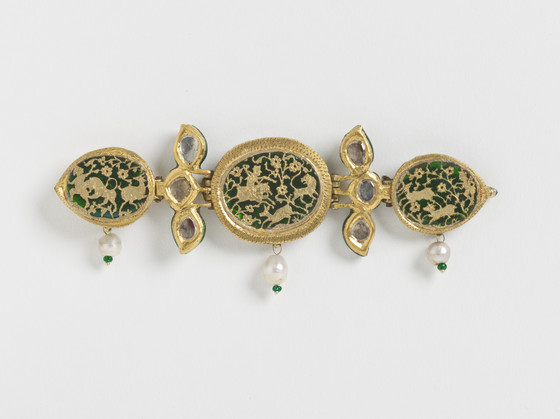
This turban ornament with its exquisite lace-like gold foil decoration is from the princedom of Pratapgarh (also spelled Partabgarh) in Rajasthan. It is fashioned in a distinctive technique termed thewa (setting) in which openwork gold foil is fused onto the surface of colored glass. The turban ornament has three major elements of horizontal oval plaques made of gilded silver. The plaques are inset with green glass faced with delicate pierced patterns of hunting scenes set against a background of flowering foliage made of chased gold foil. The back of the turban ornament is decorated with a translucent green enameled crisscross pattern and serrated leaf forms, the latter of which are fronted with rock crystal insets and hinged to accommodate the curve of the head.
The thewa technique is traditionally thought to have been invented by a Pratapgarh court goldsmith Nathuni Sonewalla in 1767. A wide range of thewa decorative objects were made in the 19th century, principally in Pratapgarh but also to a lesser extent in nearby Rutlam and Indore in Madhya Pradesh. The colored glass used in Pratapgarh works is characteristically green, whereas blue and red glass were also favored in Rutlam and Indore.
Pratapgarh plaques typically depict Europeans hunting wild game or iconic tableaux of Hindu mythology, especially Vishnu’s avatars or incarnations. Much thewa work was intended for Western consumption, by both European travelers and as export ware for foreign markets.
More...