

Curator Notes
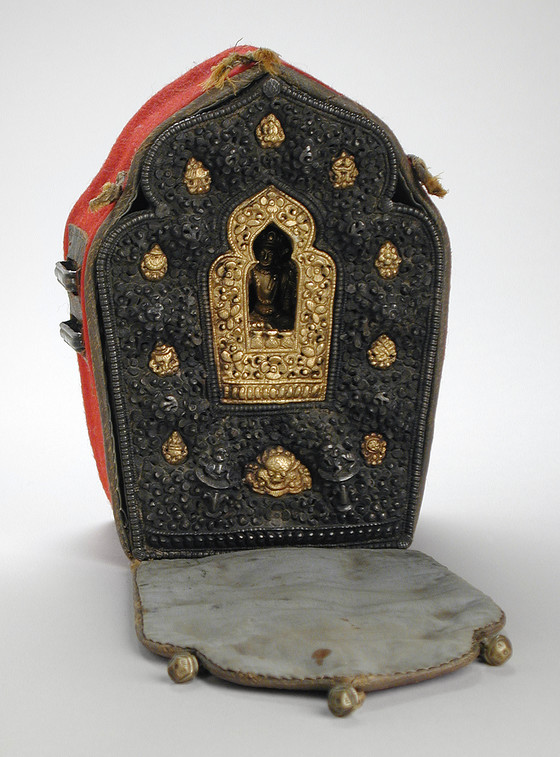
The reliquary shrine (ga'u), typically used to house a metal or an earthenware icon, and the associated amulet box (rten), commonly used to carry a paper invocation or mantra, are ubiquitous items of Tibetan religious ornaments. They are generally worn for protection while traveling, especially on a pilgrimage, but can also be worn for the promotion of health or wealth. The quality of materials and design are indicators of the wearer’s social status.
This type of ga'u is worn by men. It characteristically has a trefoil-shaped top and window in the front for viewing the inner image. The ornate front is usually an embossed silver background of scrolling flowers and openwork gold repoussé representations of the eight auspicious symbols: lotus, endless knot, golden fishes, parasol, victory banner, treasure vase, white conch shell, and the Buddhist Wheel of the Law (Dharma Chakra). There can also be additional Buddhist emblems, such as the Wheel of the Law flanked by two couchant deer (see also M.81.157.1); the zipac (shown here in the bottom row center), which is a Tibetan apotropaic symbol resembling the Indian "Face of Glory" (kirttimukha) and the Chinese gluttonous creature (taotie); flying celestials, or a miniature altar with ritual objects. The back is a removable and often adorned with a Buddhist symbol. There is usually a carrying case made of cloth and leather with hanging straps on its sides. The reliquary here is a gilt copper alloy seated image of the Bodhisattva Avalokiteshvara. See John Clarke, "Ga’u: The Tibetan Amulet Box," Arts of Asia 31:1 (May-June 2001): 45-67.
See also M.80.48.1-.2 and M.2003.20. A collection of Tibetan ga’u is in the University of Michigan Museum of Anthropology, Ann Arbor, https://webapps.lsa.umich.edu/umma/exhibits/Koelz_Collection/gau_catalog.html. See also Himalayan Art Resources, https://www.himalayanart.org/search/set.cfm?setID=2147
More...