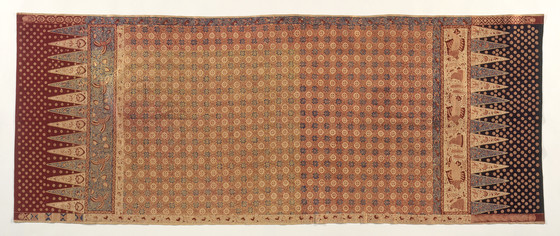
Hip wrapper, m.91.184.329
Overview
...
Hip wrapper, m.91.184.329
Overview
Excerpted from Herina, Rens, and Harmen C. Veldhuisen. Fabric of Enchantment: Batik from the North Coast of Java. Los Angeles: Los Angeles County Museum of Art; New York: Weatherhill, Inc., 1996, Catalogue no. 8.
The motifs of this opened-up sarung, with its kepala at one end, mirror each other along an imaginary horizontal line in the middle of the badan, making it possible for the cloth to be worn with the design oriented in either direction. The designs are executed in the Lasem style, with its long, spiky details, but follow the fashion for larger designs of the late nineteenth century. The phoenix-in-the-egg (sembagen huk) is depicted enclosed in a roundel suggesting a valuable imported Chinese porcelain plate (piring aji). Turtles, goldfish, gamecocks, and fruit bats surround the ships that constitute the main theme of the batik. They can be recognized as European three-masters with a high stern and fully blown sails. Obviously, the woman who drew or copied the ships had scant knowledge of maritime detail and concentrated on abundant embellishment instead. The identical papan are adorned with large centipedes, scorpions, and flying birds. In addition to the usual starflowers, small fish and cocks are lined up in the kepala. Across the center a row of larger lozenges adds a vertical accent. Backgrounds and borders abound with finely delineated floral tendrils. Red and blue (bang biru) overlap to create black on the ivory ground. Gold leaf shimmers on the part of the cloth that will be visible when worn.
Maker
Made in a Peranakan workshop, this type of batik in red overdyed with blue on a cream ground was made to be gilded. The drawing on the batik is characterized by a plethora of sharply defined, curling, elegant lines outside the motifs. This is characteristic of batiks from Lasem.
Wearer
This cloth was intended as a gift for an affluent Peranakan bride, although the scale of the motifs and color combination suggest that its use would only be appropriate later in life. The symbolism of the motifs expresses the wish that the owner of the cloth become a pillar of the community, prosperous and happily married with abundant progeny. Together the living creatures of sky, land, and sea grant the mystic power to achieve these ends. The piring aji has lost its original association with Islam and become, by association with imported Chinese porcelain, an emblem of prosperity instead. The heavily laden ships stand for the accumulation of riches and in the bridal context for the journey into marriage itself. The venomous creatures swarming the papan, an area sometimes compared with the womb, protect against danger. Particularly along the north coast the cock stands for male invincibility. In this case it probably serves as an emblem for the eminence of the groom’s family. The reversibility of the cloth was lost after it was gilded on Sumatra.
More...