Woman's Hip Wrapper (Sarung)
* Nearly 20,000 images of artworks the museum believes to be in the public domain are available to download on this site. Other images may be protected by copyright and other intellectual property rights. By using any of these images you agree to LACMA's Terms of Use.

Woman's Hip Wrapper (Sarung)

Indonesia, Java, Semarang, circa 1860-circa 1867
Costumes; !Primary
Hand-drawn wax resist (batik) on machine-woven cotton, natural dyes
42 1/8 × 77 in. (107 × 195.58 cm)
Inger McCabe Elliott Collection (M.91.184.381)
Not currently on public view

Curator Notes

Hip wrapper, m.91.184.381 Overview ...
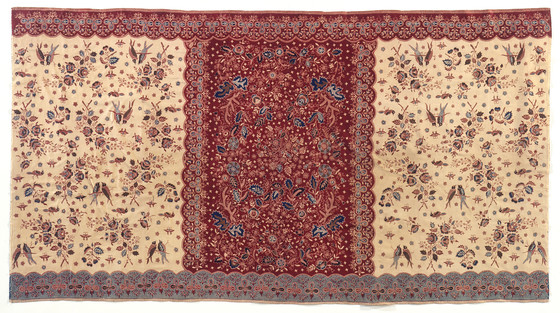
Hip wrapper, m.91.184.381 Overview Excerpted from Herina, Rens, and Harmen C. Veldhuisen. Fabric of Enchantment: Batik from the North Coast of Java. Los Angeles: Los Angeles County Museum of Art; New York: Weatherhill, Inc., 1996, Catalogue no. 18. The format of this Indo-European batik shows the classic division with the kepala bisecting the badan. Nevertheless, the impression is remarkably different, as the papan has been replaced by a wide, imitation lace border (booh)—rows of three-lobed leaves and floral sprigs—that also graces the horizontal edges of the cloth, one in red and the other a greenish soga, so the cloth can be worn with either edge on top. Although the colors resemble the traditional bang biru, this term was never used for Indo-European batiks. Moreover, the red and blue here were enlivened with soga in a shade that suggests green. The two halves of the badan are adorned with nosegays of roses and lovebirds, probably inspired by Dutch magazines. The kepala is decorated with a rather haphazard version of the earliest Indo-European floral kepala design. One selvage shows double lines; the other is plain. Maker This batik is probably from the workshop of Carolina von Franquemont. The colors, perfection of work, richness of filler motifs, and European motifs are consistent with batik produced in her shop. The format, however, represents an innovation. The side panels of the kepala have disappeared, and the bow border, in red and soga, appears along each edge. This batik is only one example of Von Franquemont’s repertoire of lovebirds. She also depicted the following stage of their love affair: two birds perched on the edge of a nest containing four eggs. Wearer Newly engaged or young married women of Indo-European and Peranakan background might have worn this cloth at home and for informal occasions. The lovebirds and abundant roses are appropriate for this stage of life. The surfeit of red, color of happiness and weddings, would appeal particularly to Peranakan taste. The more subdued greenish shade would have been preferred by Europeans.
More...

Bibliography

  • Heringa, Rens and Veldhuisen, Harmen.  Fabric of Enchantment: Batik from the North Coast of Java.  Los Angeles:  Los Angeles County Museum of Art and Weatherhill, Inc., 1996.