Hip wrapper, m.91.184.280
Overview
...
Hip wrapper, m.91.184.280
Overview
Excerpted from Herina, Rens, and Harmen C. Veldhuisen. Fabric of Enchantment: Batik from the North Coast of Java. Los Angeles: Los Angeles County Museum of Art; New York: Weatherhill, Inc., 1996, Catalogue no. 23.
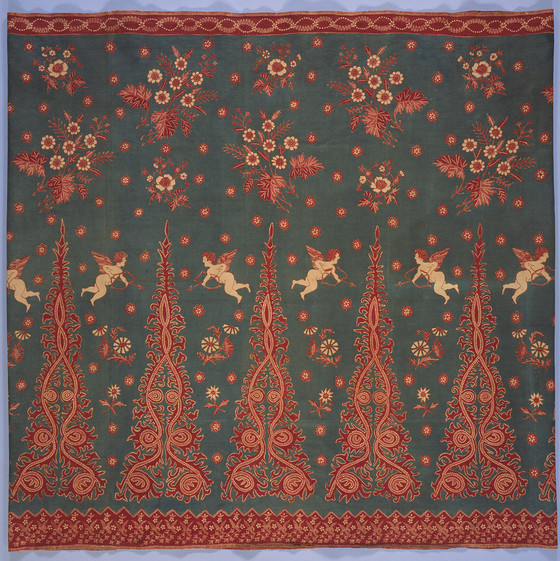
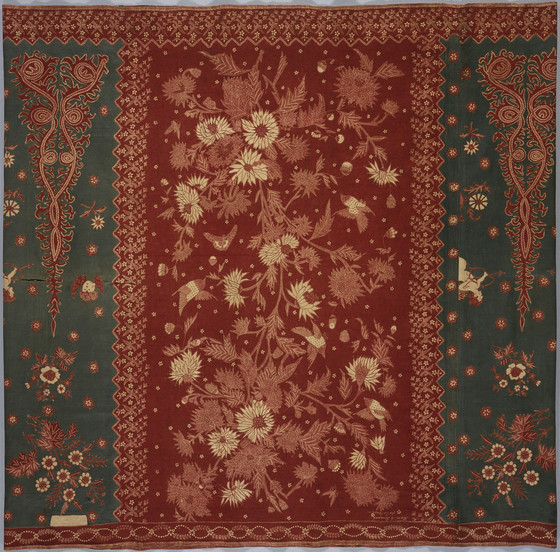
The striking terang bulan design on the badan of this hand-sewn sarung consists of seven large, abundantly decorated, red and cream triangles rising out of the lower border. The outlines are made of tiny dots that imitate the effect of the ¬tritik (stitch-resist form of tie-and-dye) technique. Interspersed between the triangle/trees are cupids with bows drawn. Cocohan enliven their bodies and other cream sections of the design. Note the angelic, disembodied head of a final cupid to the right of the kepala. Nosegays of marigolds and daisies run in bands along the upper border on a green ground scattered with starflowers or sliced starfruit. The kepala contains an asymmetrical floral arrangement, cream and pink on deep red, somewhat resembling chrysanthemums, along with birds, ¬ butterflies, and other insects drawn in European style. The red ground is sprinkled with tiny, five-petaled flowers. An elaborate lace variation embellishes the left and lower borders and runs along the kepala; the upper border shows two interwoven garlands in empire style.
Maker
Unfortunately there is no extant information on Mrs. Simons,1 who signed the upper left corner of the kepala of this batik “Mevr. A. Simons Pekalongan”; the ink stamp in the left upper corner of the badan reads, “Batikkerij A. Simons Pekalongan.” The stamp was applied to the white cotton, on which the batik maker was to work at home. It proved that Mrs. Simons was the owner of the waxed but undyed cloth and prevented its being sold by another or used as collateral. Many Lies van Zuylen batiks are similarly stamped,2 a practice that she alone among Indo-European entrepreneurs in Pekalongan shared with Mrs. Simons. The signature would have been added when the wax drawing was ¬ completed and Mrs. Simons had professed herself satisfied with its quality. Should there have been failures in the next step, dyeing, the batik would have been destroyed.
Precisely the same “faux tritik,” standing triangles, decorate the badan of a Van Zuylen sarung of about 18903 and appear on other unsigned sarung and kain panjang from Pekalongan.
Wearer
The tree of life (in the form of triangles), cupids, and European spring and summer flowers make this cloth eminently suitable for an Indo-European bride or young married woman. The Javanese and many locally born women of mixed racial descent would see the cupids as bidadari (nymphs who descend from heaven on the eve of a wedding to protect the bride and provide her a celestial countenance).4 This symbolism would have rendered the cloth suitable for a wide range of wearers. The color combination would have been particularly appealing to Indo-Arabian women.
Notes
1. Only one other piece signed by Mrs. Simons is known: a sarung in the Linden-Museum (collection no. 78217), Stuttgart (see Brigitte Khan Majlis, Indonesische Textilien: Wege zu Göttern und Ahnen [Cologne: Wienand, 1984], 195). It shows a battle scene similar to that in catalogue no. 36.
2. H. C. Veldhuisen, ¬ interview with Lies Alting du Cloux and Frieda Lewis (both daughters of Lies van Zuylen), Rotterdam, 1981.
3. H. C. Veldhuisen, Batik Belanda 1840–1940 (Jakarta: Gaya Favorit, 1993), no. 58.
4. Inger McCabe Elliott, Batik: Fabled Cloth of Java (New York: Clarkson N. Potter, 1984), 211.
More...