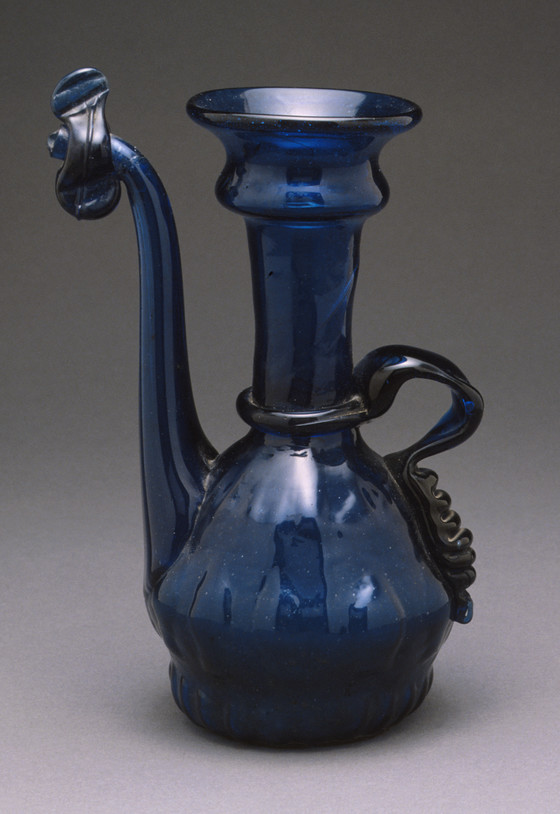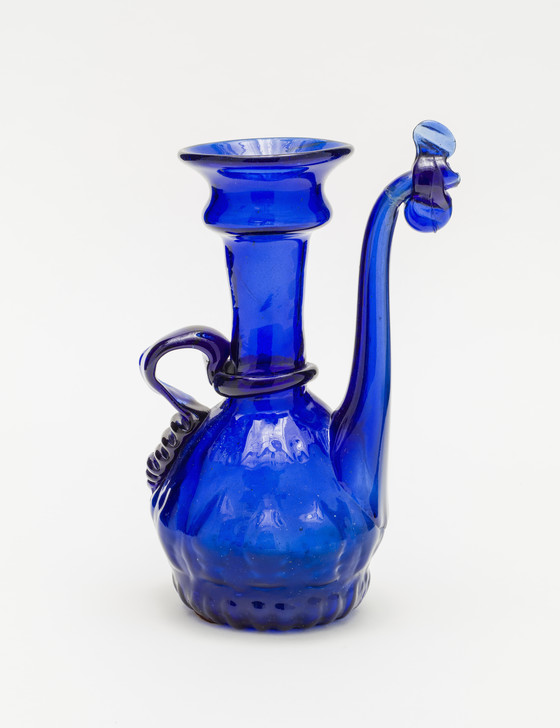
Ewer

* Nearly 20,000 images of artworks the museum believes to be in the public domain are available to download on this site. Other images may be protected by copyright and other intellectual property rights. By using any of these images you agree to LACMA's Terms of Use.

Ewer

Iran, 18th-19th century
Glass
Glass, mold-blown and free-blown, applied decoration
7 1/8 x 4 3/4 in. (18.1 x 12 cm)
Gift of Varya and Hans Cohn (M.88.129.197)
Not currently on public view

Curator Notes

Beginning in the sixteenth century, the traditional direction of glass trade from the Islamic world to Europe reversed as Venice became a major producer of high-quality glass....
Beginning in the sixteenth century, the traditional direction of glass trade from the Islamic world to Europe reversed as Venice became a major producer of high-quality glass. Yet Middle Eastern glassblowers continued to produce exceptional objects, including richly colored monochromatic vessels from Iran. This deep blue ewer—with its emphasis on an elegant, balanced shape and subtle surface decoration, such as the curving applied glass handle—is typical of nineteenth-century Iranian glass.
More...

Bibliography

  • Lo Terrenal y lo Divino: Arte Islámico siglos VII al XIX Colección del Museo de Arte del Condado de Los Ángeles. Santiago: Centro Cultural La Moneda, 2015.

  • Komaroff, Linda. Beauty and Identity: Islamic Art from the Los Angeles County Museum of Art. Los Angeles: Los Angeles County Museum of Art, 2016.
  • Lo Terrenal y lo Divino: Arte Islámico siglos VII al XIX Colección del Museo de Arte del Condado de Los Ángeles. Santiago: Centro Cultural La Moneda, 2015.

  • Komaroff, Linda. Beauty and Identity: Islamic Art from the Los Angeles County Museum of Art. Los Angeles: Los Angeles County Museum of Art, 2016.
  • Saldern, Axel von. Glass 500 B.C. to A.D. 1900: The Hans Cohn Collection. Mainz: Philipp von Zabern, 1980.
More...