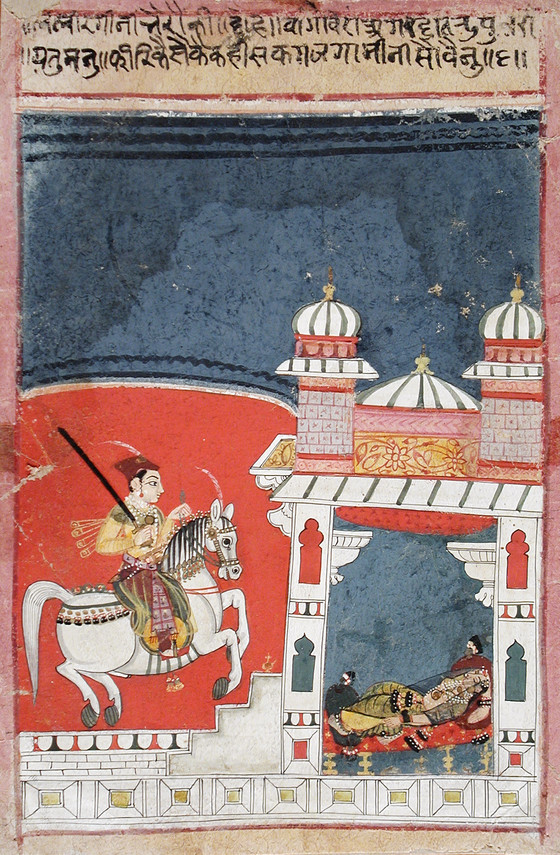
Lalita Ragini, Fifth Wife of Bhairava Raga, Folio from a Ragamala (Garland of Melodies)
* Nearly 20,000 images of artworks the museum believes to be in the public domain are available to download on this site. Other images may be protected by copyright and other intellectual property rights. By using any of these images you agree to LACMA's Terms of Use.

Lalita Ragini, Fifth Wife of Bhairava Raga, Folio from a Ragamala (Garland of Melodies)

India, Madhya Pradesh, Bundelkhand or Malwa, circa 1650
Drawings; watercolors
Opaque watercolor, gold, and ink on paper
Sheet: 9 3/4 x 6 1/2 in. (24.77 x 16.51 cm); Image: 8 1/8 x 6 in. (20.64 x 15.24 cm)
Gift of Paul F. Walter (M.87.278.11)
Not currently on public view

Curator Notes

The Hindi inscription in the header is the first couplet of the Lalita Ragini section of the influential ragamala (garland of melodies) by the 17th-century poet Lachiman Das: ...
The Hindi inscription in the header is the first couplet of the Lalita Ragini section of the influential ragamala (garland of melodies) by the 17th-century poet Lachiman Das: A tiger hero, swaggering and truculent, seeming to be the slave of Love, Who can tell when he returns, roaring like an elephant? (Translation by A. K. Coomaraswamy.) Lalita Ragini is the fifth wife of Bhairava Raga in the predominant ragamala classification system generally known as the Rajasthani system. It is a devotional melody associated with the early morning. It is personified as the arrival of the errant lover. Here, the returning lover rides his white stallion up the steps of a palatial pavilion in which the heroine lies sleeping in a bedchamber. He carries a sword against his right shoulder and has a punch dagger (katar) tucked into his waist sash. His left hand holds the reins of the horse. A water ewer is incongruously placed on the top step. A comparable Lalita Ragini, attributed to Orchha, Madhya Pradesh, circa 1640-1650, is in the Museum of Fine Arts, Boston (17.2384). It is inscribed on the reverse with the same above verse by Lachiman Das, but varies visually by the returning lover being on foot instead of on horseback.
More...