Shiva and Parvati Enthroned
* Nearly 20,000 images of artworks the museum believes to be in the public domain are available to download on this site. Other images may be protected by copyright and other intellectual property rights. By using any of these images you agree to LACMA's Terms of Use.

Shiva and Parvati Enthroned

India, Himachal Pradesh, Guler, circa 1800
Drawings; watercolors
Ink and opaque watercolor on paper
8 1/2 x 7 3/4 in. (21.59 x 19.69 cm)
Gift of Paul F. Walter (M.87.278.12)
Not currently on public view

Curator Notes

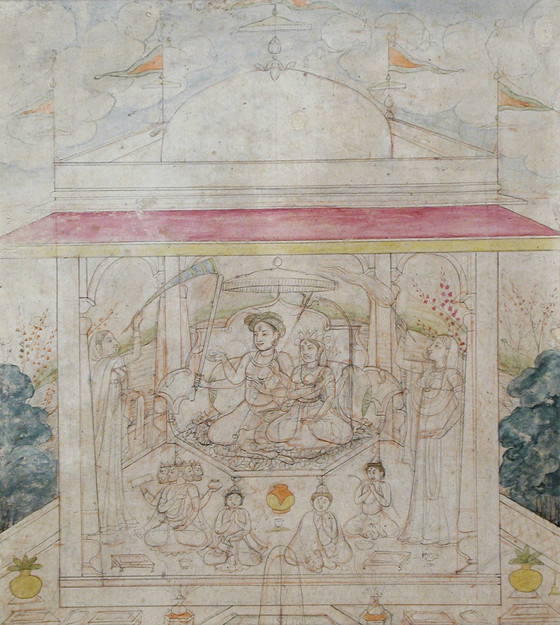
In this unfinished or preparatory drawing, the Hindu god Shiva and his wife Parvati are enthroned under a royal parasol in a pavilion flying Shiva’s standards on a palace terrace with a river in the b...
In this unfinished or preparatory drawing, the Hindu god Shiva and his wife Parvati are enthroned under a royal parasol in a pavilion flying Shiva’s standards on a palace terrace with a river in the background. Shiva has his third eye of wisdom (jñananetra). His ascetic’s long hair (jatas) is piled on his head like a turban. He wears kanphata (ear-split) rhinoceros horn earrings and a serpent for a necklace. He has four arms and carries a trident and sword. His right hand is held in the symbolic gesture of ‘gift-giving’ (varada mudra). His left hand is held near his chest. Parvati is crowned and also has a third eye of wisdom. She has four arms and holds an elephant goad and a bow. A quiver of arrows is strung over her shoulder. Her right hand is on her left shoulder while her left hand rests in her lap. Seated in front of the divine couple are the four-headed Brahma, the four-armed Vishnu, and two ascetics wearing tiger-skin garments. Female attendants wave an honorific peacock feather fan (morchal) and an honorific fly whisk made from the white tail-hairs of a yak (cauri or chowri). In front of the group and outside on the terrace are a waterpot covered with a cloth, bowls, footed trays, ritual conch shells, and potted plants. The tree foliage along the sides are impressionistic. The bottom edge and sides may have been trimmed.
More...

Bibliography

  • Pal, Pratapaditya.  The Classical Tradition in Rajput Painting.  New York: The Gallery Association of New York State, 1978.