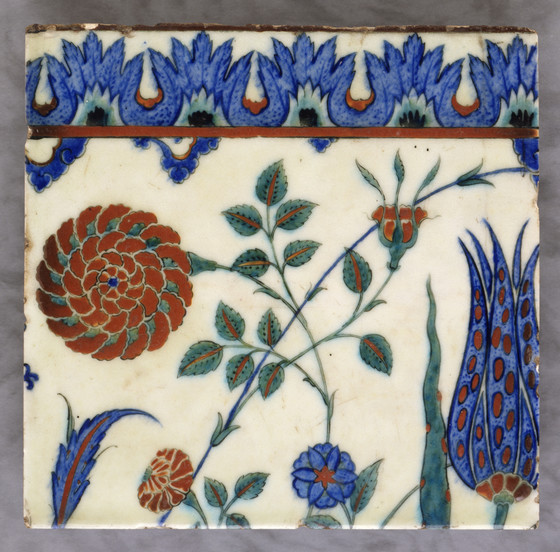
Tile

* Nearly 20,000 images of artworks the museum believes to be in the public domain are available to download on this site. Other images may be protected by copyright and other intellectual property rights. By using any of these images you agree to LACMA's Terms of Use.

Tile

Turkey, Iznik, c. 1575
Ceramics
Fritware, underglaze painted
10 1/4 x 10 5/8 in. (26.04 x 26.99 cm)
Purchased with Funds Provided by Mr. and Mrs. Allan C. Balch and the Art Museum Council (M.87.103)
Not currently on public view

Curator Notes

Ceramics made in Iznik, in western Turkey, represent one of the most renowned and influential arts of the Ottoman period....
Ceramics made in Iznik, in western Turkey, represent one of the most renowned and influential arts of the Ottoman period. The Iznik kilns, about eighty-five miles southeast of the capital, Istanbul, produced both tableware and architectural revetment such as this. Tiles were first manufactured at Iznik around the early sixteenth century, however, production increased dramatically in the second half of the century as the court sponsored more and more new buildings. In the second half of the sixteenth century the addition of bright red and green to the palette of Iznik ceramics expanded the creative possibilities of the style, and painters became more adventurous in their compositions. This tile was clearly part of a larger arrangement perhaps depicting an otherworldly flowering garden; the distinctive border at the top with its serrated-edge palmettes helps to link the tile with examples preserved in other museum collections. Objects of this type, both tile revetment and vessels, demonstrate the great variety of ornament used by Iznik potters, including the ubiquitous tulip; lush, plump peonies, rose and carnations; and spiky and scrolling leaves. They also help to illustrate the different stylistic phases of Iznik wares, which in turn reflect the evolution of Ottoman taste in the sixteenth and seventeenth centuries in a variety of mediums.
More...