Born in Osaka. In 1928, he graduated from Department of Commerce, Kansei Gakuin University and held a solo exhibition in Osaka Asahi Kaikan. In 1934, following advice from Foujita Tsuguharu (Leonard Foujita), he sent his paintings to the Nika-kai and they were selected for the 21st Nika Exhibition. In 1938, he was involved in organizing the Kyushitsu-kai group with avant-garde artists of the Nika-kai. In 1952, he was involved in forming Gendai Bijutsu Kondan-kai (Genbi) as an organizer, the group of artists from across media that explored modernization in design. Then in 1954, he organized the Gutai Art Association (Gutai bijutsu kyōkai) and devoted himself to the group as its leader. He organized the Gutai Art Exhibitions, from the 1st to the 21st, in Japan and abroad. In 1962, he opened the Gutai Pinacotheca, Gutai’s exhibition space, in Nakanoshima, Osaka. He won the golden award at the Triennale-India in 1971. The following year, he died in Ashiya, Hyōgo Prefecture at the age of 67. - Osaka City Museum of Modern Art
Mostly self-taught painter founded the Gutai group in 1954, wrote the manifesto that defined it, and continued to support its activities during his lifetime. Though members of Gutai Bijutsu Kyōkai (Concrete Art Association) were involved in actions and performance, Yoshihara remained exclusively an abstract painter. - Getty
Though Yoshihara had admired Fujita Tsuguharu in the early 1930s, the government demand that artists produce work to support the war effort from 1939 to 1943 ended with Yoshihara producing impenetrably vague abstracted views of torment and difficulty, while Fujita became the foremost among war art painters. Yoshihara was excused from the draft due to tuberculosis, and retreated to a village named Sanda, This background prepared Yoshihara for the artistic revolution that he would begin to foment upon return to Ashiya in 1945. Most of the other early Gutai members had been drafted into the war effort. Yoshihara spent the immediate postwar years teaching, and creating designs for theater as well as graphic design. His efforts to raise the profile of artists in the Kansai region sest the stage for the national recognition of Gutai. The Ashiya City Exhibition, which began in 1948 became a magnet for later Gutai members such as Motonaga Sadamasa, Mukai Shūji, and Nasaka Yūko. Another ground for Gutai growth was the group Gendai Bijutsu Kondankai (genbi), founded by Muramatsu Kan in 1952, where Yoshihara served as founding member and steering committee member. In 1954 he founded Gutai which he hoped would "lead to an international common ground where the arts of the East and the West influence each other". - Drawn from Ming Tiampo, "Please Draw Freely" in "Gutai: Splendid Playground", New York: Guggenheim, 2013, pp. 45-79.
"We are following the path that will lead to an international common ground where the arts of the East and the West will influence each other. And this is the natural course of the history of art." 1958. (Martha Jackson Gallery, New York)
Yoshihara's mission statement included the quote, "Do what no one has done before," encouraging artists to produce work as a path toward liberation following fascist rule, occupation, and exclusionist attitudes in America towards other countries in their promotion of Abstract Expressionism as an American art. Yoshihara's aim was to create a zone for mutual influence between countries around the world.
Yoshihara and Tanaka Atsuko's works were included in a 1964 Guggenheim International Award exhibition in New York, which aimed to show the individualism of artists from all regions in a non-hierarchical way. Despite such efforts, the commonly used textbook, "Art Since 1900", continues to describe Gutai as derivative of Abstract Expressionism.
Yoshihara was able to build up and support his artist associations as he came from a wealthy merchant family and was a successful business person. For Gutai, he assembled a group of sixteen artists around Osaka, Kobe and Kyoto and produced a journal, "Gutai", beginning on January 1, 1955, based on his appreciation of art journals such as "Shirakaba", "Minotaure", and "Abstraction-Creation", and encouraging workers in the plastic arts to, "pursue fresh emotions", and to work with artists in adjacent fields such as music, dance, cinema, theater, etc.
After the end of American occupation in 1952, Yoshihara and other Gutai members were invited to participate in exhibitions internationally, including in that year Paris' Salon de Mai and Pittsburgh International. Yoshihara encountered paintings by Jackson Pollock first at an Osaka version of Yomiuri Indpendent Exhibition in 1951. Yoshihara called Pollock's work, "psychological realism", explaining that the psychological experience of the human being is resolved in Pollock's painting through direct action unfiltered by objective references. In his theories, substance itself and the artistic gesture produced a direct connection psychologically between the artist and their work. He explained this as, "drops of paint are more beautiful than that which they present, " and continuing in his "Gutai Art Manifesto" by saying that the drip painting, "reveals the scream of matter itself, cries of the paint and enamel." Gutai artists went further than Pollock, who painted within the frame, by physically struggling with their materials to produce reflections of their direct encounter with raw paint.
Yoshihara and the French critic who advanced Art Informel from Paris, Michel Tapie, came to know of each other first through circulation of their respective journals. Similarly, promoter of Happenings, American Allan Kaprow, found Gutai through their journals. While drawn to each other's work, each of the Euro-American groups layered their understanding of Yoshihara's theories and Gutai art with preset understandings of Zen Japan. However, Tapie found in the Gutai artists and their theories a basis for explicating the Art Informel's movement of action painting as a means of conveying pure emotion and experience. Tapie would collaborate with Yoshihara for about the next ten years producing co-exhibitions of works by Art Informel and Gutai artists in Osaka, Tokyo, New York, Paris and Turin. [Tapie had been introduced to Gutai members by Dōmoto Hisao and would meet Yoshihara for the first time in Osaka in 1957 during the planning of their co-exhibition.The version of the exhibition for New York appeared also at the Pasadena Art Museum in 1958.] Yoshihara praised in Georges Mathieu's work "the individual's character and the selected materiality [which] meld together in the furnace of automatism..." indicating a continuance of the psychological underpinnings of surrealsm, which was deeply impactful in Japan. Yoshihara diferrentiated Gutai from surrealism based on the latter's attachment of "titles and significations". It is notable that Mathieu's painting always kept a clear design with less emphasis on material, in contrast to Gutai artists who allowed their paints and other materials to move freely over the surface, maintaining chance as a major ingredient in the final product.
In the late 1950s and early 1960s, Yoshihara arranged for Gutai Association artists to participate in influential exhibitions abroad and in Japan mixing their art with that of artists from Europe and America. In 1959, Gutai showed at Arte Nuova at Turino Circolo degli Artisti, and in 1960 organized an exhibition The International Sky Festival, each of 30 artists suspending an artwork tethered to a balloon over a department store in Osaka. They appeared also in the exhibition "Nul" in 1965 with its new generation rejecting Art Informel in favor of producing art that would alter one's perception of time, space and body. The Nul group in Europe had come across Gutai's prescient experiments in performance through a book co-written by Yoshihara, Tapie, and Haga Tōru in 1961 entitleld "Continuite et avant-garde au Japon". In 1968, Jean Clay of the French art journal "Robho" dedicated an issue of the magazine to Gutai, with Yoshihara's input. There he redefined Gutai for western audiences away from the "Zen spirit" described by Michel Tapie to "performance and event-based art on a large scale" which activated those areas before artists in New York and Paris would. Clay argued for the reevaluation of Gutai in a time when colonialist art critics had made it appear inconsequential by labeling it as derivative. Thought began to shift at this point to the idea that transnationalism was basic to modernization.
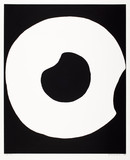
After experiencing the "Nul" exhibition and recognizing Gutai's presence in the international network of artists, Yoshihara turned to making Circle paintings from 1965 until his death in 1972. He remained true to gestural art against a matte ground, evoking the ensō as a cultural sign of philosophical power, but transforming it into a zero. In these he combined pure painting with personal and historical art. For Expo '70 in Osaka, younger members who had joined Gutai after 1961, created participatory environments charged by sound, light, mirrors to distort and motorization within an overall space planned by Isozaki Arata and his director, Tange Kenzō. The Gutai Art Festival of 1970, held again at Isozaki's Festival Plaza, engaged viewers with constant motion, sound, smoke-borne color and strobe lights.
As the spokesman and promoter of the group, following Yoshihara's death in 1972, Gutai dissolved.
Above drawn from "All the Landscapes; Gutai's World" by Alexandra Munroe in "Gutai: Splendid Playground", New York: Guggenheim, 2013, pp. 20-43.
Jirō Yoshihara
1 records
Include records without images
About this artist