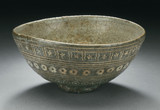
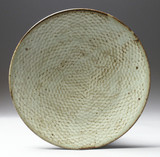
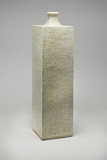
Pucker Gallery - Shimaoka Tatsuzō lived and worked in Mashiko, Japan, a town renowned for its pottery traditions brought to fame by Hamada Shōji. Originally, Shimaoka studied pottery at the Tokyo Institute of Technology and then apprenticed under Hamada (1894-1978) before establishing his own kiln and complex in Mashiko in 1953. From 1950 to 1953, Shimaoka worked at Tochigi Prefecture Ceramic Research Center where he developed many of his signature rope inlay decoration techniques. From the 1960s to the 1980s, Shimaoka traveled around the world and was invited to exhibit in North America, Asia, and Europe. In Japan, he was given many awards for his distinguished work and contribution to traditional Japanese folk art. The technique of jōmon zōgan (rope-impressed inlay) earned him the honor of Japanese Living National Treasure in 1996.
Born the son of a kumihimo maker, Shimaoka's interested in rope patterning was hard-wired from youth. Two areas of particular interest for him were German salt-glazing techniques and Korean hakeme brush slip patterning. Adoption of motifs from Hamada are found in his brushed-on splash patterns in loop shape (referred to a "fish tail").
Tatsuzō Shimaoka
11 records
Include records without images
About this artist